How to Read Skincare Ingredient Lists Without Guessing the Formula
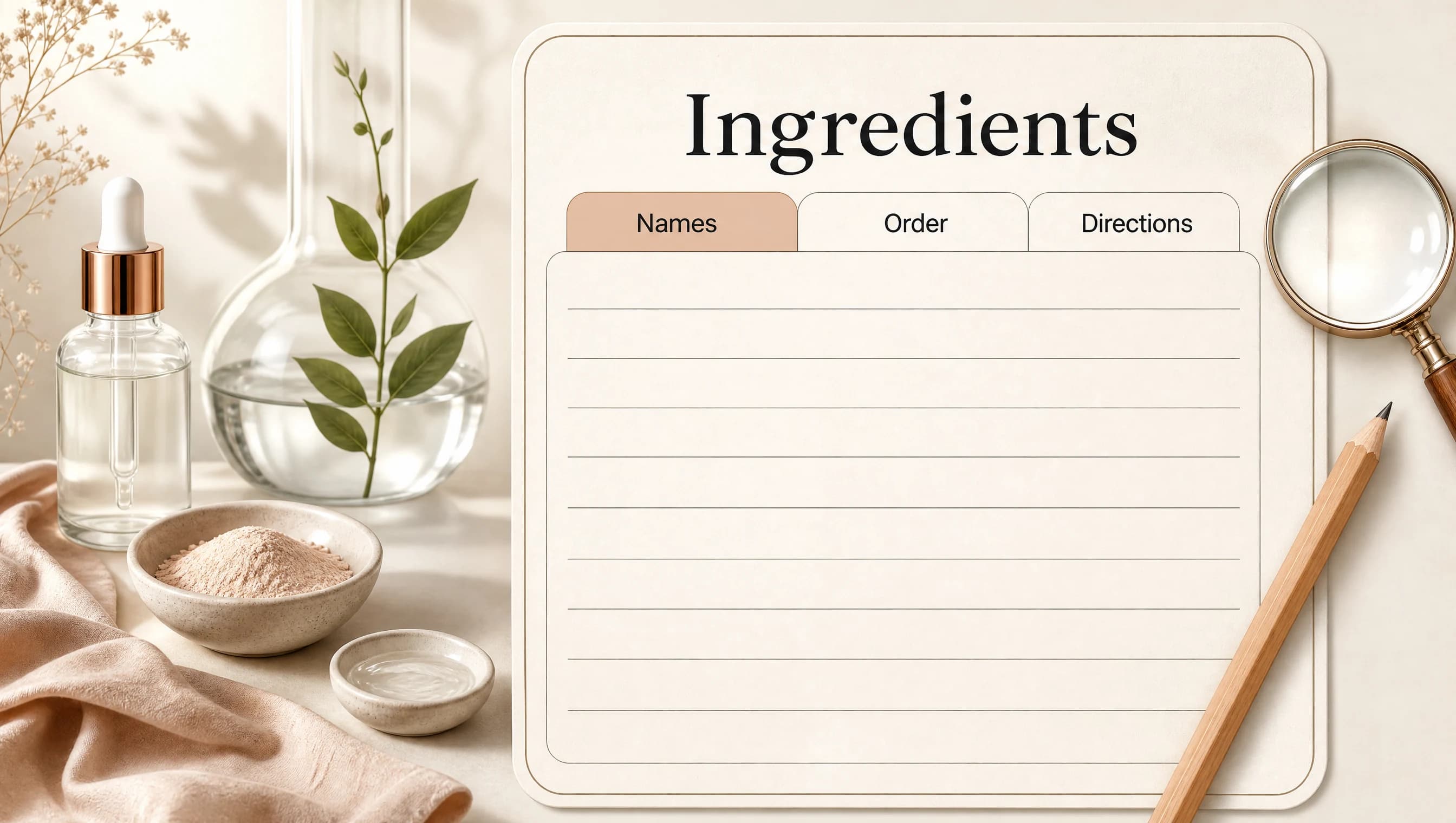
Read a skincare ingredient list to answer specific questions: is an ingredient present, does it conflict with a known restriction, and is this the formula I meant to buy? Do not expect the list to reveal every concentration, prove performance, or reconstruct the manufacturer's recipe.
Start with the exact product and market. A similar bottle name, a different SPF version or an older product photograph can send you to the wrong list before you have even begun comparing ingredients.
Ingredient order has a useful limit
For US cosmetics, the FDA's labeling guide describes a generally descending order of predominance. Ingredients at one percent or less can be listed in any order after those above one percent; color additives have additional exceptions. The list normally does not draw a line showing where that lower-concentration group begins.
That means “lower on the list” is not a reliable concentration calculator. You also cannot compare two formulas by counting how many ingredients appear before a familiar name and announcing which contains more.
| What the panel shows | A reasonable conclusion | An unsupported leap |
|---|---|---|
| A named ingredient | It appears in the displayed formula | Its exact percentage |
| General ingredient order | Some information about relative predominance | A complete recipe |
| A short or long list | How many declared items are shown | Which product must be safer or more effective |
| A different list from your old box | A reason to investigate the version | Proof of a particular concentration change |
Read the panel in three passes
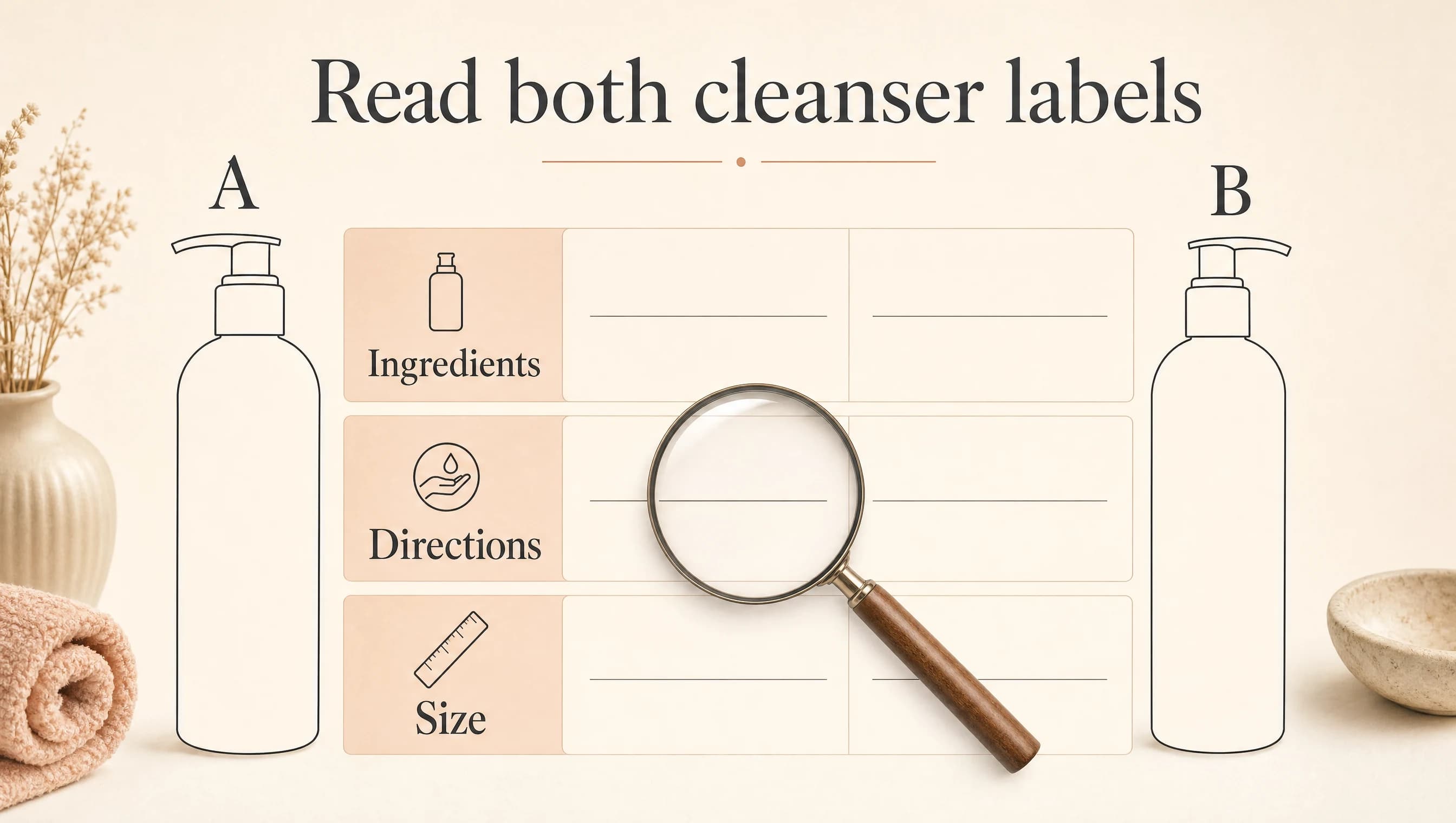
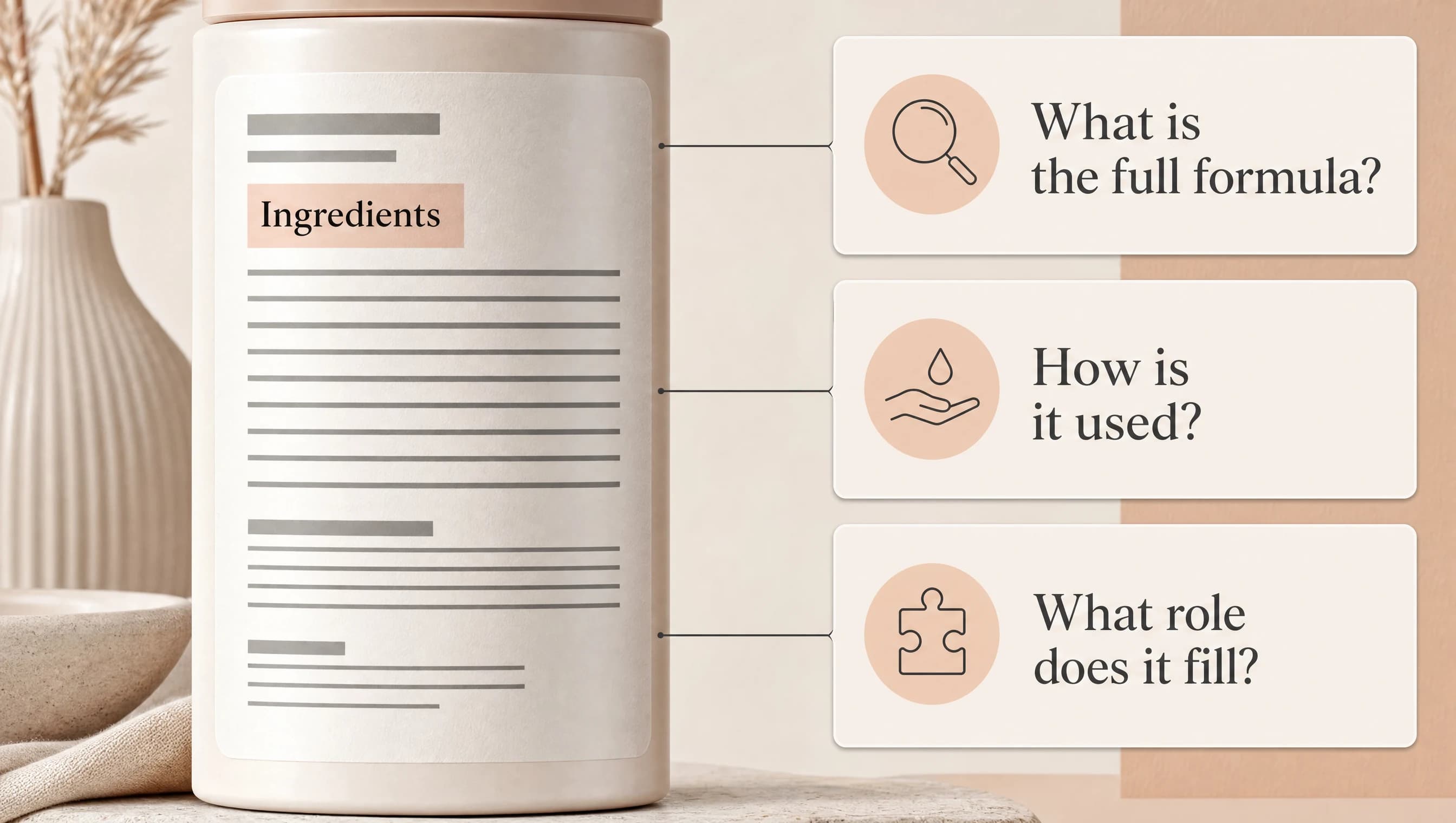
Identity: match the full name, country, product type and any suffix such as cream, lotion, SPF or fragrance-free. Keep a photo of the actual package rather than relying only on a retailer's copied text.
Personal restrictions: compare known allergens or ingredients your clinician has told you to avoid. Do this before getting distracted by an attractive headline ingredient. A formula can contain an ingredient you want and another that makes it unsuitable for your circumstances.
Role: read the directions alongside the ingredients. A rinse-off wash and a leave-on product can share a familiar ingredient while doing different jobs. Keep the intended area and method beside your ingredient notes.
Here is a completed reading exercise using the already discussed name “Hyaluronic Acid 2% + B5 with Ceramides.” The full name helps identify the current version. “With Ceramides” tells you what to investigate in its ingredient list; it does not disclose every ceramide concentration. The manufacturer’s explicit update statement supports a reformulation, while the order of a name alone would not establish the size of that change.
| Question in the exercise | Answer available | Leave unknown |
|---|---|---|
| Which version am I reading? | The named version with Ceramides | Whether a retailer will ship that version until the listing is confirmed |
| Was a change announced? | The manufacturer explicitly describes an updated formula | The exact quantitative change for every ingredient |
| Does the list prove it suits me? | It can be checked against known exclusions | Individual tolerance and comparative results |
Do not confuse different kinds of label information

Some products, including certain sunscreens and acne treatments in the US, have drug labeling as well as cosmetic ingredient information. Active-ingredient declarations serve a different purpose from the general cosmetic list. Read the relevant directions and warnings rather than treating every panel as the same kind of data.
Fragrance is another limitation. The FDA explains that fragrance components can be declared collectively as fragrance under US rules. The absence of a detailed list of individual fragrance components is therefore not enough to answer every allergy-related question.
If front-label reassurance is the main source of confusion, read what hypoallergenic means. For routine selection beyond the ingredient panel, use beginner skincare routine guide and sensitive-skin product guide.
Compare two versions without inventing a cause
Place the ingredient photographs side by side. Note names that appear, disappear or move. Also record the exact product title and region. Then look for a manufacturer statement about the change or ask about the version and lot you have.
The Ordinary's current Hyaluronic Acid 2% + B5 with Ceramides page, for example, explicitly describes an updated formula. An explicit brand explanation is stronger evidence of a reformulation than a shopper guessing from packaging color alone.
Our reformulation-check guide walks through that comparison. For a concrete serum-selection example, our hyaluronic acid formula guide considers the complete product rather than treating an ingredient name as a verdict.
Frequently asked questions
Are the first five ingredients all that matter?
No. That shortcut can miss relevant ingredients elsewhere in the formula, including ingredients that matter to a personal restriction. Read the full list.
Can I calculate the percentage from ingredient order?
Usually not. The label's ordering rules and exceptions do not supply a complete set of concentrations, and the one-percent boundary is generally not marked.
Is a shorter ingredient list automatically better?
No. Length alone does not establish suitability. Focus on the product's role, your restrictions, its directions and the actual information available about the finished formula.
Sources
FDA: Cosmetics Labeling Guide (fda.gov) — https://www.fda.gov/cosmetics/cosmetics-labeling-regulations/cosmetics-labeling-guide
FDA: Fragrances in cosmetics (fda.gov) — https://www.fda.gov/cosmetics/cosmetic-ingredients/fragrances-cosmetics
The Ordinary: Hyaluronic Acid 2% + B5 with Ceramides (theordinary.com) — https://theordinary.com/en-us/hyaluronic-acid-2-b5-serum-with-ceramides-100637.html
Clear guidance, checked before publication.
Solvi articles are structured by our editorial team and reviewed for clarity, consistency, and responsible health language. We update pages when guidance or product information changes.