Glycerin vs Hyaluronic Acid: A Practical Label Guide
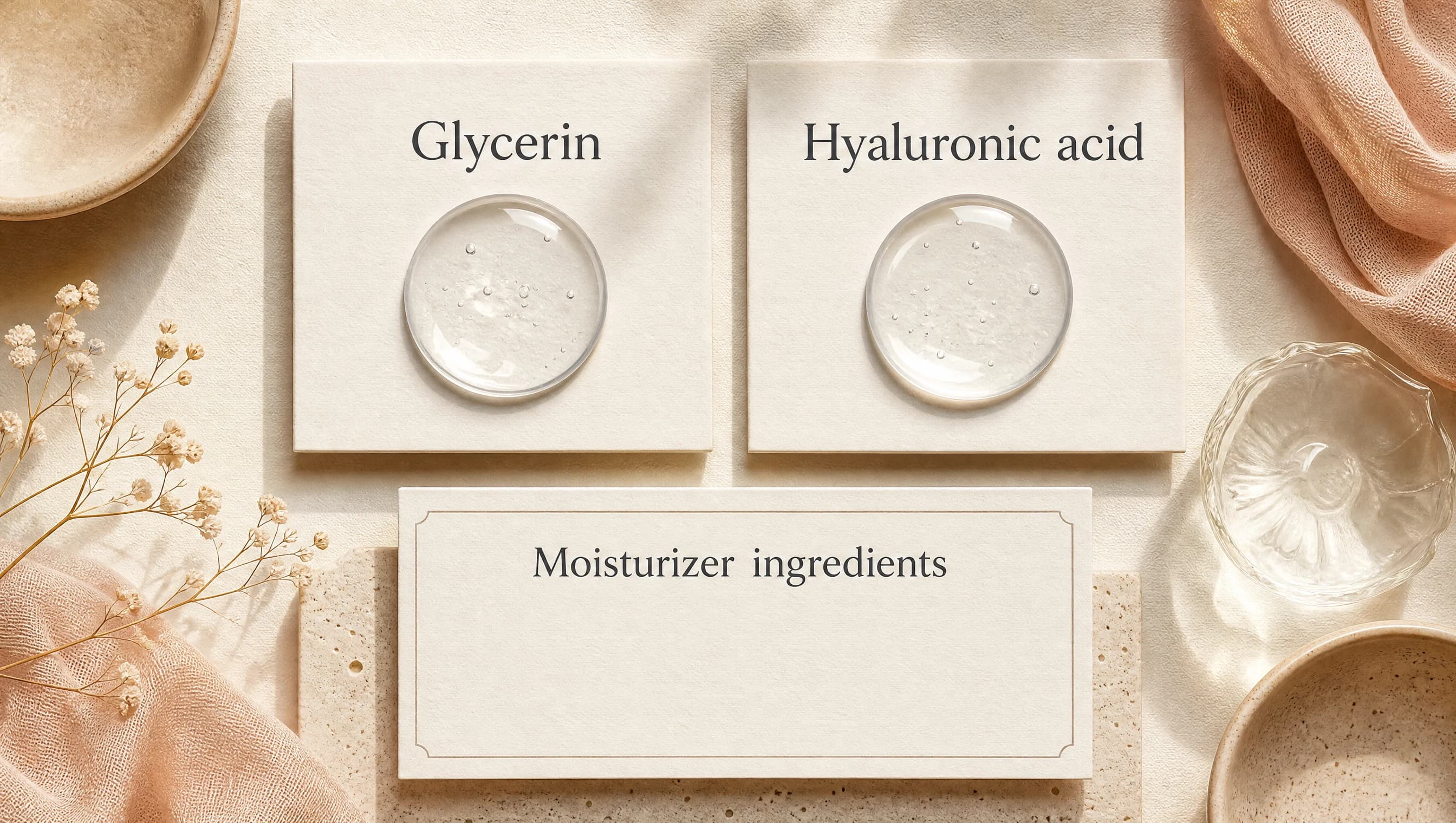
Glycerin and hyaluronic acid are both humectants: ingredients used to help retain water in moisturizing formulas. You do not necessarily need to choose one over the other. Many finished products contain both, so the more useful decision is which complete formula meets your needs without adding a redundant step.
A prominent hyaluronic acid claim does not prove that a product hydrates better than a moisturizer containing glycerin. This guide compares label choices, not ingredient concentrations or measured performance.
Compare roles before comparing names
A humectant is one part of a moisturizing formula. Other ingredients can affect softness, consistency and moisture retention. The finished product therefore matters more than a contest between two familiar names.
| What you find on your moisturizer | What it tells you | Useful action |
|---|---|---|
| Glycerin | A humectant is already present | Do not assume a separate HA serum is required to add a humectant |
| Hyaluronic acid or sodium hyaluronate | An HA ingredient is already present | Check what a second hydrating product would change |
| Both | The front-label ingredient contest is a false choice for this formula | Decide by the finished product’s comfort and role |
| No disclosed concentration | The list does not supply the percentage | Leave the percentage unknown rather than guessing |
DermNet includes both among ingredients used in moisturizing or barrier formulas. The table is a guide to interpreting labels; it is not a measurement of how deeply either ingredient absorbs or how long a particular product works.
Check two real moisturizer examples
Vanicream Daily Facial Moisturizer lists glycerin and hyaluronic acid. CeraVe Daily Moisturizing Lotion lists glycerin and sodium hyaluronate. Both illustrate why a front-label comparison can create a choice that the ingredient list does not require.
These are examples of ingredient presence, not a recommendation that one formula will suit everyone. They also do not establish that the two products have matching concentrations, texture or results. The package in your own market is the relevant final reference if the list differs from the page reviewed here.
For a closer comparison of other ingredient roles, see ceramides versus hyaluronic acid. Humectants and lipid-related ingredients can appear together without either making the other unnecessary.
Decide what is actually missing
A completed example: “My current lotion already lists glycerin and sodium hyaluronate. It feels comfortable, and I have no separate hydration goal.” The practical result is to keep the lotion and skip the extra serum for now. If the actual complaint is a heavy finish under sunscreen, compare the finished moisturizer’s texture instead of shopping for another humectant name.
A new serum adds a product with its own complete formula. It may also add another application step and another opportunity for a texture mismatch. That does not make serums inherently unnecessary; it means the reason for adding one should be clear.
Use our dehydrated-feeling skin moisturizer guide to compare whole-product options. If the main concern is persistent discomfort, our skin-barrier concern checklist can help you record what changed rather than diagnose the problem from a single symptom.
Compare products without inventing a score
A practical comparison can stay modest and useful:
- Confirm that both products are intended for the area you plan to use them on.
- Read their complete ingredient lists and directions.
- Note whether your current moisturizer already contains either humectant.
- Compare the format and additional steps each choice requires.
- Record the actual size and price if cost is part of your decision.
Do not compare a percentage printed for one ingredient with an undisclosed percentage in another product. Similarly, two products mentioning “hyaluronic acid” may contain different related ingredients and supporting formulas. The word alone cannot establish equivalence.
Keep application practical
Follow the product's directions. The presence of glycerin or hyaluronic acid does not create a universal requirement for multiple layers, a facial mist or a particular waiting time. Our guide to hyaluronic acid on damp or dry skin explains why serum directions and general moisturizer advice are separate questions.
For visibly flaky areas, use our dry, flaky skin moisturizer guide to revisit the overall format and routine. Persistent or worsening symptoms deserve assessment rather than a series of purchases built around different humectant names.
Frequently asked questions
Can glycerin and hyaluronic acid appear together?
Yes. The reviewed Vanicream and CeraVe moisturizers provide two current examples. Check your own package because formulas and markets can differ.
Is sodium hyaluronate an unrelated ingredient?
It is a hyaluronic-acid-related ingredient commonly encountered on labels. Its presence still does not reveal the finished product's performance.
Should I replace a comfortable moisturizer with an HA serum?
There is no automatic reason to do that. Identify what the change would accomplish and keep the complete product role in view.
Sources
DermNet: Barrier cream ingredient roles (dermnetnz.org) — https://dermnetnz.org/topics/barrier-cream
Vanicream: Daily Facial Moisturizer (vanicream.com) — https://www.vanicream.com/product/vanicream-daily-facial-moisturizer
CeraVe: Daily Moisturizing Lotion (cerave.com) — https://www.cerave.com/skincare/moisturizers/daily-moisturizing-lotion
Clear guidance, checked before publication.
Solvi articles are structured by our editorial team and reviewed for clarity, consistency, and responsible health language. We update pages when guidance or product information changes.