AHA vs BHA vs PHA: Choose an Exfoliant by the Job
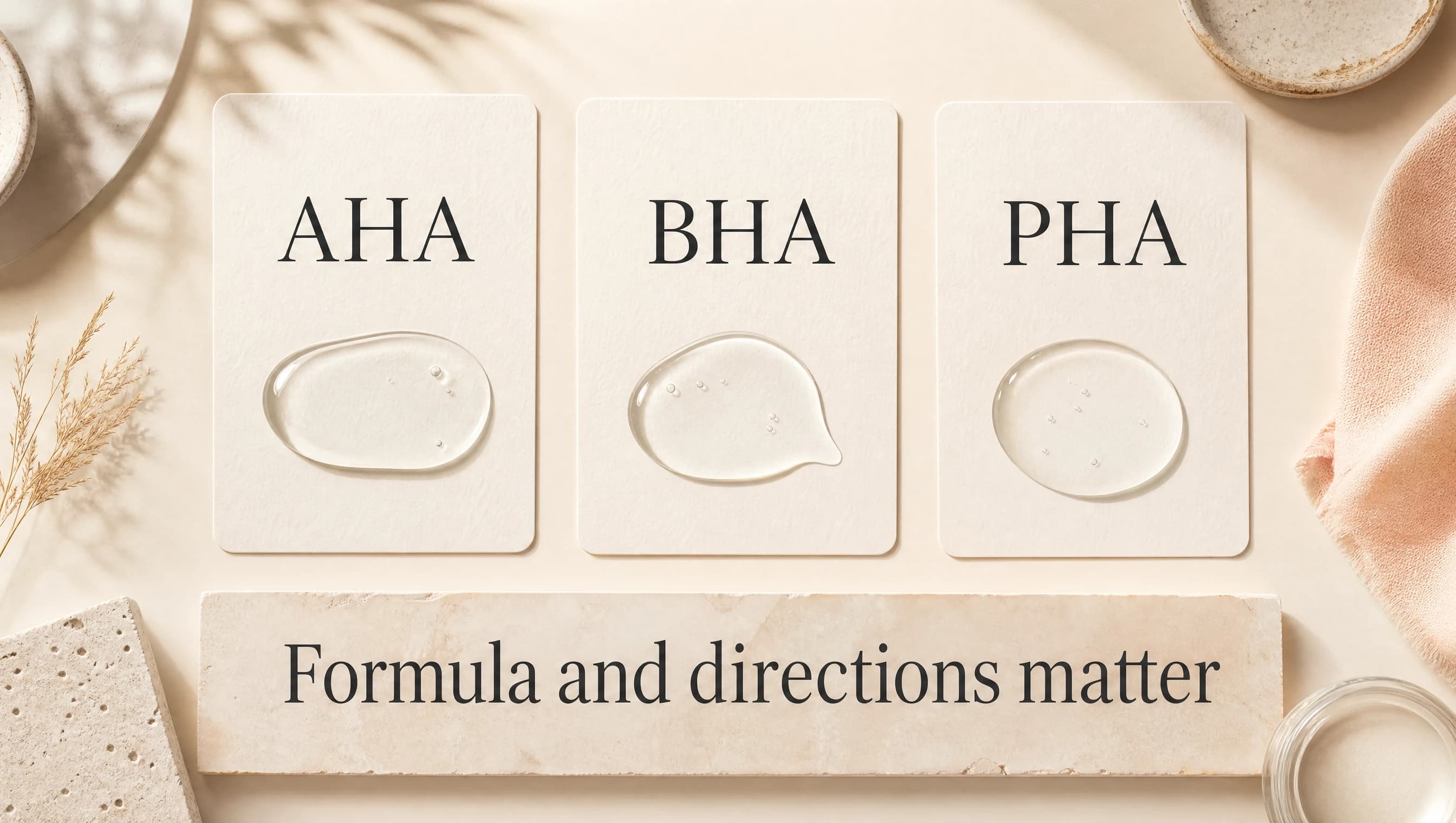
Use AHA, BHA and PHA as a way to narrow a product search, not as three steps you need in one routine. An AHA is one option for cosmetic surface-texture concerns; a salicylic-acid product is worth investigating when your specific concern matches its acne or congestion label; a PHA is another exfoliating option when tolerability is a priority. No family is automatically best or irritation-proof.
The finished product matters more than a neat ingredient ranking. Concentration, formulation, instructions and the products already in your routine change the decision.
Translate the initials into a shopping decision
| Family | Examples on labels | Useful first question | Mistake to avoid |
|---|---|---|---|
| AHA: alpha hydroxy acid | Glycolic or lactic acid | Does this product address the surface-texture concern I have? | Assuming every acid percentage is comparable |
| BHA: the common cosmetic term | Salicylic acid | Is this a cosmetic exfoliant or an acne medicine, and what does its label say? | Using medication directions as an all-purpose skincare schedule |
| PHA: polyhydroxy acid | Gluconolactone | Does this particular formula fit my tolerability needs? | Reading “gentle” as a guarantee |
FDA guidance identifies glycolic and lactic acids as common AHAs and salicylic acid as the most common ingredient called BHA in cosmetics. The family name helps locate a product category; it does not settle the purchase.
Compare labels rather than building an acid collection
The Ordinary Glycolic Acid 7% Exfoliating Toner is a named AHA example. The INKEY List PHA Toner discloses 3% gluconolactone. A salicylic-acid acne product may carry medication directions. These examples illustrate different decisions, not a three-product routine.
Write each candidate's instructions beside its name. Include whether it rinses off, where it may be used and any restrictions that affect your existing routine. If you cannot tell whether a product is supposed to remain on the skin, resolve that question before buying it.
A completed inventory makes the first decision smaller: “I already use a salicylic-acid cleanser that I like. I am considering an AHA toner because I think a routine should contain every acid family.” The gap is a routine rule, not an identified need. Keep the useful cleanser and pause the extra purchase while you decide whether there is a separate cosmetic goal.
What the evidence says about gentler PHA claims
A 2004 study compared gluconolactone-containing and glycolic-acid-containing regimens over 12 weeks. The PHA regimen was better tolerated on several irritation measures. The authors' listed affiliation included NeoStrata, and the study evaluated particular regimens.
That is evidence worth considering, but it does not test every PHA bottle against every AHA bottle. It also does not show that a product cannot sting or cause a reaction. Claims such as “zero irritation for sensitive skin” are broader than this study can establish.
In practical terms, prior difficulty with one exfoliant is a reason to reconsider the formula and the need for exfoliation. It is not a reason to buy the next family with confidence that its name solves the problem.
Make the first choice smaller
Use this checklist before adding any acid:
- Name one outcome you want, using everyday language rather than a list of ingredient benefits.
- Identify whether another product already addresses it.
- Compare one candidate's full instructions with your current routine.
- Keep the rest of the routine familiar while deciding whether the new step is useful.
- Retain sun protection and follow any product-specific warnings.
FDA AHA guidance warns about increased sun sensitivity and recommends protection during use and for a week afterward. Applying an AHA only at night does not cancel that precaution.
If the target concern is persistent or unclear, a dermatologist can help separate a cosmetic texture question from a condition that needs a different approach.
Frequently asked questions
Is PHA always better for sensitive skin?
No. Some research supports better tolerability for studied PHA regimens, but individual products and individual reactions differ. A family name cannot guarantee a comfortable result.
Can I use AHA, BHA and PHA together?
Do not construct a combination simply to cover all three. Some finished products combine ingredients, but that does not establish the safety or usefulness of stacking separate formulas.
Which acid works fastest?
There is no reliable speed ranking from these labels alone. Compare the intended purpose and evidence for the actual product instead of choosing a higher number to force a quicker change.
Related decisions
- Best Facial Exfoliator for Sensitive Skin: A Smarter Way to Choose
- Best face wash for blackheads: a practical salicylic guide
- Skin Cycling Routine for Beginners: A Calm, Customizable Four-Night Plan
- Glycolic acid vs lactic acid — Compare two individual AHAs after choosing the broader exfoliant family.
- Salicylic acid cleanser vs serum — Compare rinse-off and leave-on formats if BHA is the relevant option.
Sources
FDA: Alpha hydroxy acids (fda.gov) — https://www.fda.gov/cosmetics/cosmetic-ingredients/alpha-hydroxy-acids
FDA: Beta hydroxy acids (fda.gov) — https://www.fda.gov/cosmetics/cosmetic-ingredients/beta-hydroxy-acids
Edison et al., 2004: Comparison of PHA and AHA regimens (pubmed.ncbi.nlm.nih.gov) — https://pubmed.ncbi.nlm.nih.gov/15002657/
The INKEY List US: PHA Toner (theinkeylist.com) — https://www.theinkeylist.com/products/pha-toner
The Ordinary US: Glycolic Acid 7% Exfoliating Toner (theordinary.com) — https://theordinary.com/en-us/glycolic-acid-7-exfoliating-toner-100418.html
Clear guidance, checked before publication.
Solvi articles are structured by our editorial team and reviewed for clarity, consistency, and responsible health language. We update pages when guidance or product information changes.