Niacinamide 5% vs 10%: Choose the Formula, Not Just the Number
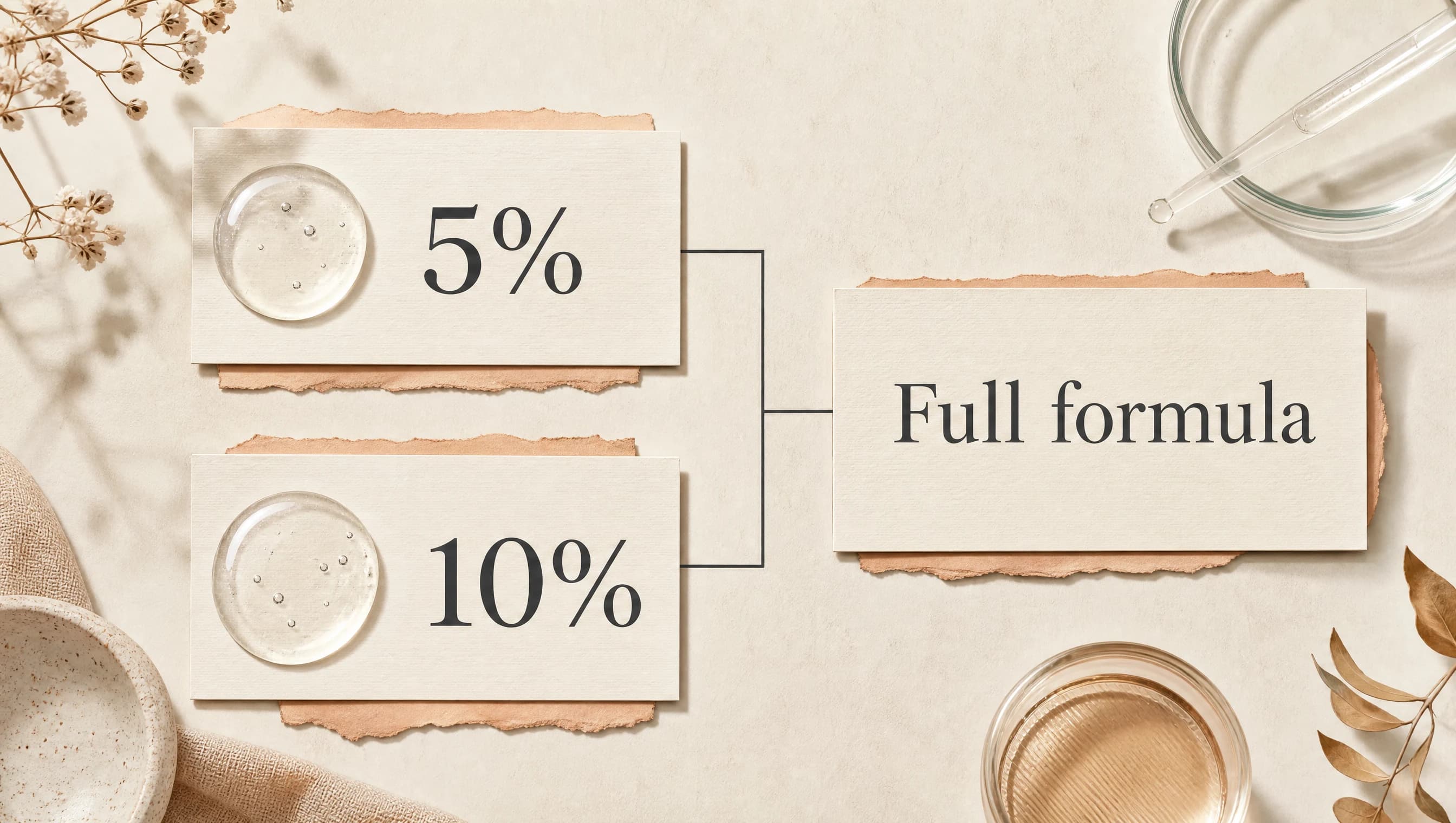
Choose between 5% and 10% niacinamide by the finished product you want to use, not by treating the higher number as an automatic upgrade. For a concrete comparison, The Ordinary offers a 5% face-and-body emulsion and a 10% + Zinc 1% water-based serum. Those are different formulas with different formats, not the same bottle at two strengths.
If your current niacinamide product is comfortable and serves its purpose, the percentage alone is a weak reason to replace it. If you are buying for the first time, start with the role, texture and instructions you can actually evaluate.
Compare these actual formulas
| Your priority | Relevant named formula | Keep this distinction |
|---|---|---|
| A face-and-body emulsion with tone-focused positioning | Niacinamide 5% Face and Body Emulsion | The manufacturer positions this exact product for uneven-looking tone; 5% is not an all-skin tolerance guarantee |
| A water-based facial serum with visible-shine positioning | Niacinamide 10% + Zinc 1% | Its format and stated targets differ from the 5% emulsion |
| Your current niacinamide step is comfortable and useful | Keep the existing product | The larger percentage alone supplies no reason to upgrade |
| Niacinamide is already in a moisturizer you like | Check whether a separate serum has a distinct job | An undisclosed moisturizer percentage cannot be put on a 5%-versus-10% scale |
The manufacturers’ current targets make the comparison more useful than a percentage contest. These are different products with different positioning; the labels do not establish a head-to-head efficacy or tolerance winner.
Identify what you want the extra step to do
Write one sentence before shopping: “I want this product because ___.” A particular texture, an uneven-looking tone concern or a preference for one product across face and body is more useful than “I should use a stronger serum.”
If hydration is the actual reason you opened the shopping tab, compare niacinamide and hyaluronic acid before choosing a concentration. A label percentage does not tell you whether you have chosen the ingredient category you intended to buy.
For a tone-focused shortlist, our niacinamide serum guide considers the broader product decision. Use a comparison to narrow choices, not to add several overlapping serums at once.
Check whether your moisturizer already covers the step
There is a third option: keep a moisturizer you like and skip a separate niacinamide purchase. La Roche-Posay Toleriane Double Repair Face Moisturizer lists niacinamide among its ingredients. Its reviewed page does not disclose a niacinamide percentage, so it cannot be placed on a 5%-versus-10% scale.
That does not make it incomplete. A moisturizer and a targeted serum are different purchase decisions. If you are satisfied with the moisturizer and have no specific reason to change the routine, another bottle is optional.
Our moisturizer guide for sensitive skin helps keep that choice focused on the whole formula.
Make a fair decision without creating a home experiment
You do not need to put 5% on one cheek and 10% on the other to justify a purchase. Instead, make the choice traceable:
- Record the full product name, including “Face and Body” or “Zinc 1%.”
- Check the instructions on the pack you will use.
- Decide which existing step, if any, the product replaces.
- Introduce one change rather than buying both comparison products together.
- Keep notes on practical issues such as dispensing, finish and how the routine fits your day.
Comfort is a reason to keep or reconsider a product, not proof that one concentration is medically right for everyone. If a formula causes a reaction, do not assume you must tolerate it to benefit from the ingredient.
For another genuinely different choice, our azelaic acid versus niacinamide guide separates the products' roles from their similar-looking percentages.
Read compatibility at the product level
The Ordinary's current 10% serum page lists both direct and indirect vitamin C under its do-not-use-with guidance. That is a practical instruction for this product range; it should not become a claim that every niacinamide-and-vitamin-C formula is unsafe.
Our niacinamide and vitamin C layering guide provides broader context. Where a particular manufacturer's instructions are more restrictive, follow those instructions or ask the manufacturer about your exact combination.
Frequently asked questions
Is 10% niacinamide twice as effective as 5%?
That does not follow from the concentration. A reliable comparison would need relevant finished-product evidence, not arithmetic on the front label.
Is 5% automatically the best option for sensitive skin?
No universal conclusion follows from the number. The complete formula, your history and the product's directions still matter.
Do I need niacinamide serum if my moisturizer contains it?
Not automatically. Decide whether the serum addresses a clear priority that your current routine leaves unresolved.
Sources
The Ordinary: Niacinamide 5% Face and Body Emulsion (theordinary.com) — https://theordinary.com/en-us/niacinamide-5-face-body-serum-100661.html
The Ordinary: Niacinamide 10% + Zinc 1% (theordinary.com) — https://theordinary.com/en-us/niacinamide-10-zinc-1-serum-100436.html
La Roche-Posay: Toleriane Double Repair Face Moisturizer ingredients (laroche-posay.us) — https://www.laroche-posay.us/our-products/face/face-moisturizer/toleriane-double-repair-face-moisturizer-3337875839969.html
Clear guidance, checked before publication.
Solvi articles are structured by our editorial team and reviewed for clarity, consistency, and responsible health language. We update pages when guidance or product information changes.