Niacinamide vs Hyaluronic Acid: Which Gap Are You Filling?
Choose a hyaluronic-acid product when you are specifically looking for an additional hydrating step. Investigate a niacinamide product when its stated cosmetic goals—such as visible shine or uneven-looking texture—match your concern. You may also need neither serum if your existing routine already does the job.
The names are not rival versions of the same ingredient. More importantly, a bottle's headline ingredient does not describe its entire formula. A moisturizer can already contain one or both, and buying separate serums can duplicate steps without answering a new need.
Compare the jobs before the bottles
| Your actual question | Useful starting point | Check before buying |
|---|---|---|
| I want another hydrating layer | A hydration-focused formula | Whether your moisturizer is already sufficient |
| Visible shine is my priority | A niacinamide formula with that stated purpose | The complete formula and directions |
| My routine feels sticky or pills | Review the number and amount of layers | Do not assume a missing ingredient is the cause |
| I like my routine and have no clear gap | Keep it stable | No serum purchase is required |
For a concrete label comparison, The Ordinary positions its Niacinamide 10% + Zinc 1% around several cosmetic concerns including visible shine and texture. Its Hyaluronic Acid 2% + B5 with Ceramides is positioned around hydration. Those are manufacturer descriptions of particular products, not a head-to-head clinical trial.
Read the ingredient overlap
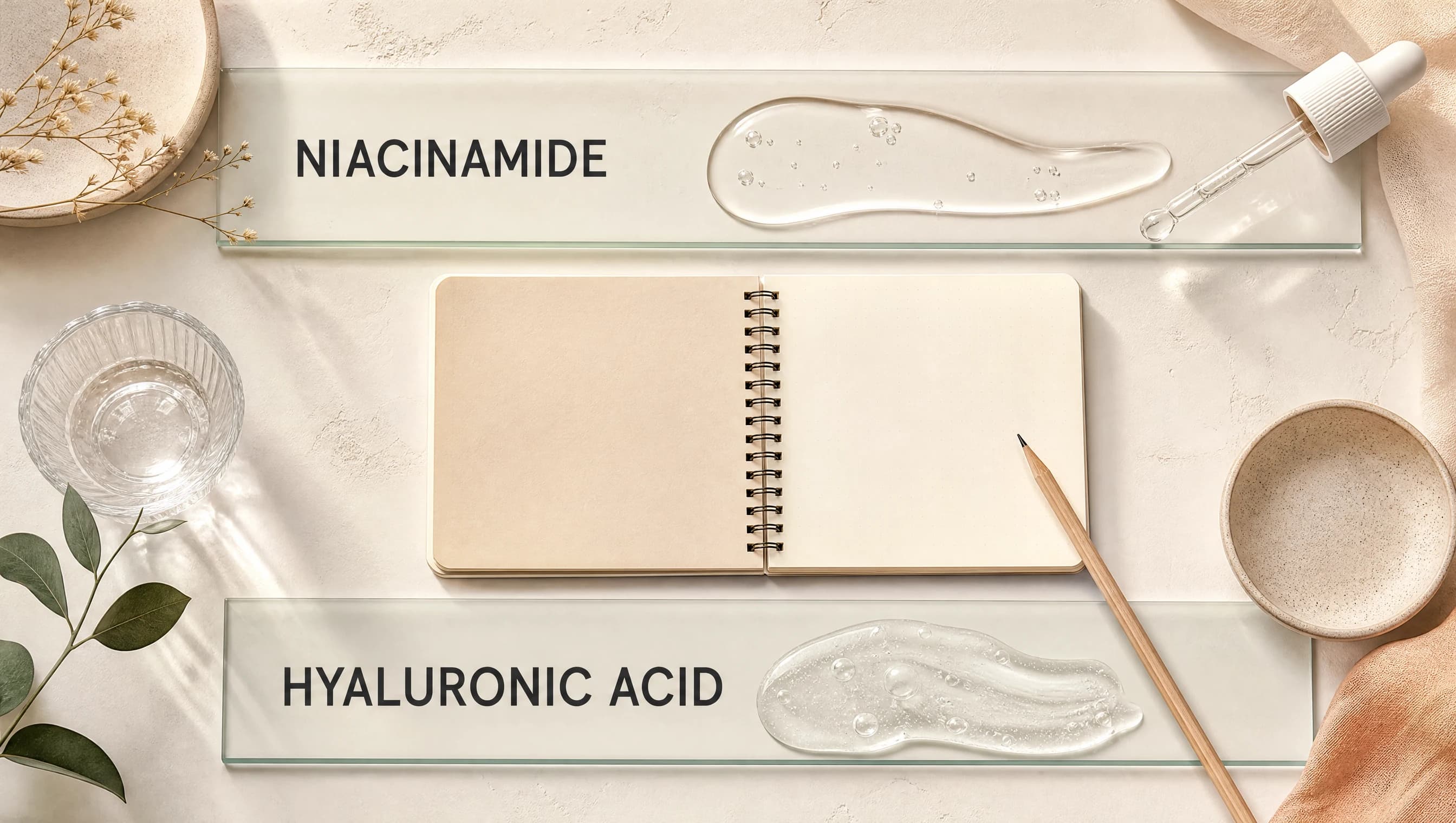
Look at products you already use before building a new shopping list. Write each product's main role in a notebook: cleanse, moisturize, protect, or optional treatment. Then note whether niacinamide or a form of hyaluronic acid is already listed.
Ingredient presence does not tell you its exact concentration or guarantee a result. It simply prevents a common mistake: assuming that only a product with “serum” on the front can contain a desired ingredient.
The Ordinary's example HA serum contains additional ingredients, including ceramides and panthenol. Its niacinamide example also contains zinc PCA. Comparing them as pure niacinamide versus pure hyaluronic acid would misdescribe both bottles.
A practical one-product decision
Consider three situations. In the first, your face feels comfortable after moisturizer and you are curious about a trending HA serum. There is no clear problem to solve, so waiting is a reasonable decision.
In the second, visible shine is the specific concern and your basic routine feels comfortable. A niacinamide product marketed for that purpose is a coherent candidate to investigate. It is not a promise that your skin will become matte, and persistent acne deserves its own assessment rather than an ingredient-label shortcut.
In the third, your skin feels persistently uncomfortable despite several serums. Buying a different active may obscure the simpler questions: which product changed, what happens after cleansing, and does a particular formula sting? Our sensitive-skin serum guide helps organize that decision.
If you decide to keep both
There is no inherent shopping rule requiring a choice of only one ingredient for life. But follow the directions for the actual formulas, introduce changes separately, and assess whether each step earns its place. A general ingredient comparison cannot override a manufacturer's product-specific instruction.
The AAD's budget routine centers on cleansing, moisturizing and protection. Use that as a useful spending check: optional serums should not crowd out the basics you rely on.
Choose a follow-up from the unresolved question: glycerin versus hyaluronic acid compares hydration-focused ingredients; niacinamide 5% versus 10% explains why concentration needs the exact formula context.
Frequently asked questions
Does everyone need a hyaluronic-acid serum?
No. A separate serum is one possible format for a hydration-focused product. Your moisturizer may already be adequate, and a new step should have a clear purpose.
Is niacinamide an exfoliating acid?
Niacinamide is a form of vitamin B3, not another name for an AHA or BHA. Do not classify a complete product solely by that headline ingredient; inspect any additional actives.
Can I replace moisturizer with either serum?
Do not assume interchangeability from ingredient names. Compare the products' intended roles and how the complete routine performs; a water-based serum and your moisturizer may serve different practical needs.
Sources
The Ordinary: Niacinamide 10% + Zinc 1% (theordinary.com) — https://theordinary.com/en-us/niacinamide-10-zinc-1-serum-100436.html
The Ordinary: Hyaluronic Acid 2% + B5 with Ceramides (theordinary.com) — https://theordinary.com/en-us/hyaluronic-acid-2-b5-serum-with-ceramides-100637.html
AAD: Skin care on a budget (aad.org) — https://www.aad.org/public/everyday-care/skin-care-basics/care/skin-care-budget
Clear guidance, checked before publication.
Solvi articles are structured by our editorial team and reviewed for clarity, consistency, and responsible health language. We update pages when guidance or product information changes.