Hydrating Toner vs Exfoliating Toner: Read Past the Bottle
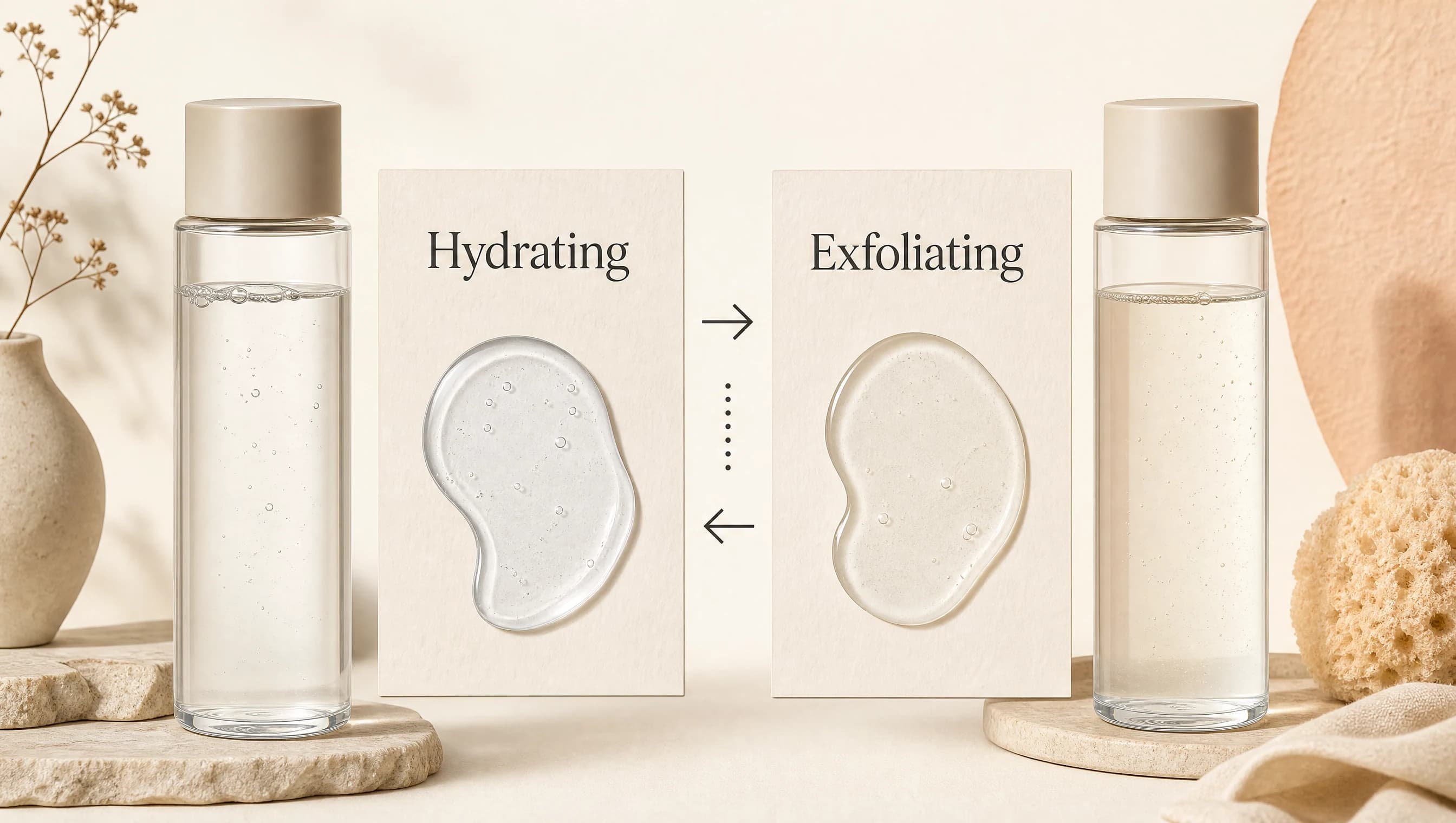
A hydrating toner is chosen for an extra hydration-focused layer. An exfoliating toner is chosen for an exfoliation step and must be treated according to its active ingredients and directions. Similar packaging does not make them interchangeable, and an exfoliating toner does not become a basic hydrating product simply because it also contains humectants.
Choose the job first. If you cannot name what the new toner would add, the bottle shape and the word glow are not enough to justify another step.
Compare the role before the texture
| Question | Hydrating toner | Exfoliating toner |
|---|---|---|
| Main reason to consider it | An optional hydration-focused layer | A specific exfoliation purpose |
| Useful label clues | Hydration claims and supporting ingredients | Named exfoliating actives and use warnings |
| What the texture tells you | How you may prefer to apply it | Not its strength or safety |
| Routine question | Does it add comfort beyond current products? | Does another product already exfoliate? |
| Common mistake | Assuming every toner is essential after washing | Using it like an unrestricted splash of water |
An ingredient list needs context. Citric acid, for example, can serve a formulation role rather than proving a product is intended as an exfoliant. FDA guidance notes that AHAs can also be used to adjust pH. Read the product's stated purpose and directions alongside the ingredients.
Two real products make the distinction clearer
CeraVe Hydrating Toner is marketed for hydration and lists ingredients including glycerin, niacinamide, ceramides and sodium hyaluronate. The Ordinary Glycolic Acid 7% Exfoliating Toner explicitly identifies glycolic acid and an exfoliating purpose.
These are examples of different roles, not a recommendation to use both. If you replace the first with the second while keeping the same casual application habits, you have changed more than a brand. You have introduced an active step that deserves its own directions.
The CeraVe ingredient list also includes citric acid. That illustrates why scanning for the word acid without context can misclassify a formula. The two products are not equivalent because both contain ingredients whose names include acid.
Work backward from the problem you want to solve
If your complaint is that your routine feels dry or uncomfortable, first identify when that happens. Is it after cleansing? After a treatment? Only under makeup? Buying an exfoliating toner because its label promises smoothness may not answer the hydration question that started the search.
If your goal is a particular cosmetic texture change, check whether an existing serum, cleanser or pad already provides exfoliation. Choosing a second bottle from another category does not give it a separate purpose automatically.
Consider someone with a comfortable cleanser, moisturizer and sunscreen who wants a lighter-feeling extra layer. A hydration-focused toner is the relevant category to evaluate, though it remains optional. Someone already using an acid serum needs to review overlap before adding a toner advertised for resurfacing.
Make a keep-or-skip shopping note
Use these decisions before purchase:
- Keep an optional hydrating toner when you can name the comfortable, useful role it already plays.
- Before adding an exfoliating toner, identify whether it would replace an existing acid step or duplicate it.
- Skip a new toner when its only job is to complete a routine diagram.
- For any chosen product, record the actual directions and restrictions; “toner” does not supply them.
This makes it easier to reject a product with impressive claims that do not match your actual need. It also prevents a common shopping loop: adding hydration to offset an exfoliant you did not need, then buying another active because the routine now feels complicated.
For an AHA toner, keep its sun-protection precautions. The FDA's warning about AHA-related sun sensitivity is relevant even when the product also contains soothing or hydrating ingredients.
Frequently asked questions
Can an exfoliating toner also hydrate?
Yes, a formula can contain ingredients with several roles. That does not cancel its exfoliating purpose or the directions and warnings attached to that purpose.
Can I use both types in the same routine?
First establish why both are needed and whether the formulas' instructions fit together. Owning two different categories is not evidence that layering them improves your result.
Does a toner replace moisturizer?
Do not assume that from the name. Evaluate whether your routine remains comfortable and follow the products' instructions. A toner purchase is not a reason to remove a moisturizer that is already useful.
Related decisions
- Best Facial Exfoliator for Sensitive Skin: A Smarter Way to Choose
- Best face wash for blackheads: a practical salicylic guide
- Skin Cycling Routine for Beginners: A Calm, Customizable Four-Night Plan
- Do you need toner — Decide whether any toner has a useful role before choosing a toner type.
- Aha vs bha vs pha — Identify the exfoliating acid family rather than assuming every exfoliating toner behaves alike.
Sources
CeraVe US: Hydrating Toner (cerave.com) — https://www.cerave.com/skincare/cleansers/hydrating-toner
The Ordinary US: Glycolic Acid 7% Exfoliating Toner (theordinary.com) — https://theordinary.com/en-us/glycolic-acid-7-exfoliating-toner-100418.html
FDA: Alpha hydroxy acids (fda.gov) — https://www.fda.gov/cosmetics/cosmetic-ingredients/alpha-hydroxy-acids
Clear guidance, checked before publication.
Solvi articles are structured by our editorial team and reviewed for clarity, consistency, and responsible health language. We update pages when guidance or product information changes.