Gel Moisturizer vs Cream: Choosing a Useful Texture
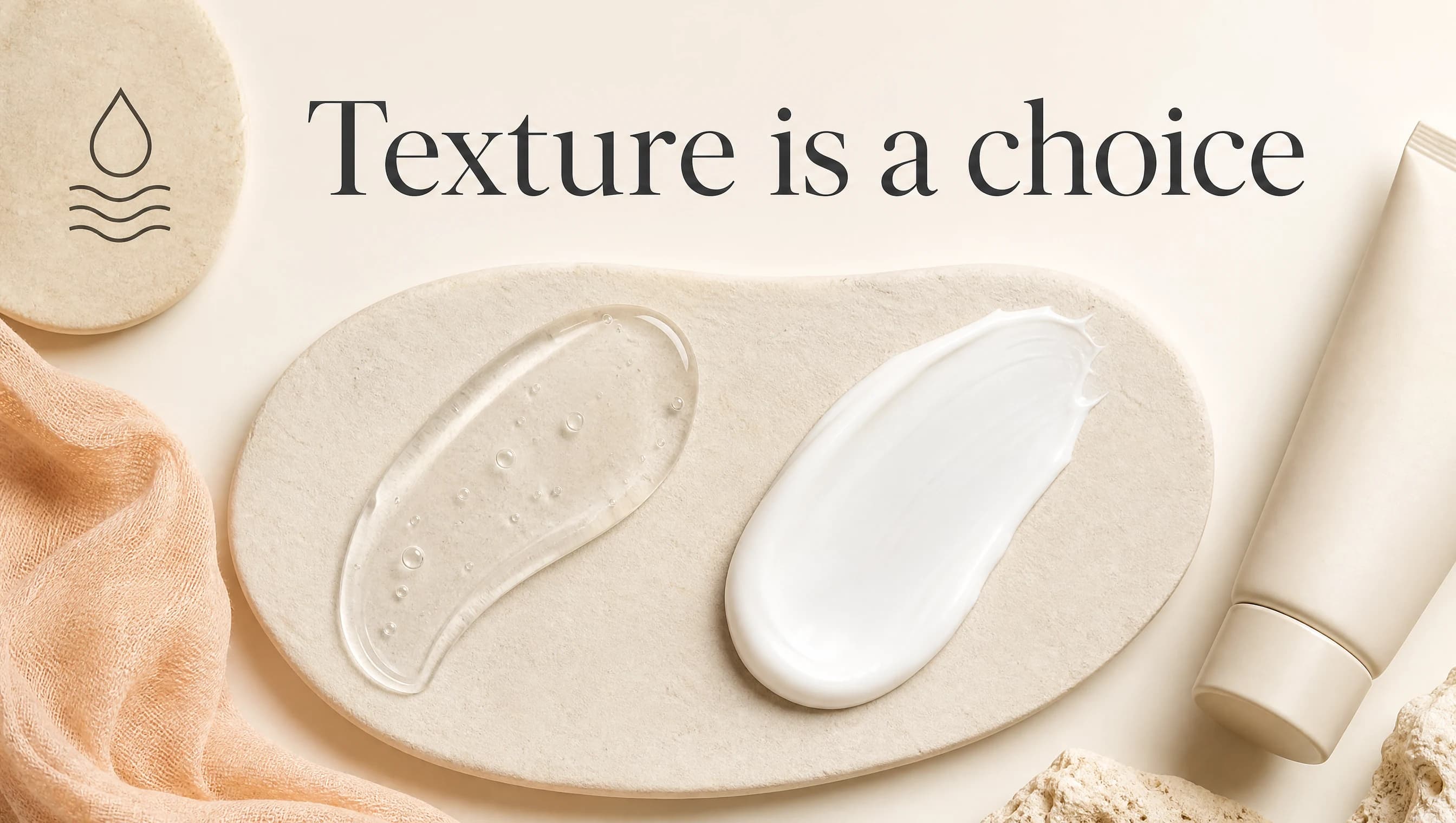
Choose a gel moisturizer when a lighter-feeling format is your main preference; consider a cream when you want a richer format. Then check the complete product. Gel and cream are useful descriptions, but they do not reliably tell you every ingredient, the exact finish or whether a formula will suit your skin.
The choice becomes easier when you name the situation: a humid commute, dry cheeks, an uncomfortable current texture, or too many layers under sunscreen.
Three real products show why the names are only a start
| Labeled example | Manufacturer format | What it teaches |
|---|---|---|
| The Ordinary NMF + Beta Glucan | Gel | A gel can still contain several moisturizing ingredients |
| The Ordinary NMF + HA | Cream | A cream is a complete formula, not only its headline ingredient |
| Neutrogena Hydro Boost Gel Cream Fragrance Free | Gel cream | Hybrid names do not fit a simple two-box rule |
These examples come from the Beta Glucan, NMF + HA and Hydro Boost Gel Cream pages. They illustrate formats rather than rank products. None establishes how every gel or cream behaves.
Match the texture to the place it will be used
Think in terms of a specific part of your day. If a rich layer feels distracting in warm, humid weather, comparing a lighter format may make sense. If your cheeks feel persistently dry while a light product suits other areas, consider whether the amount or format on those areas needs review.
That does not require buying a separate moisturizer for every zone. First describe the mismatch. Is it discomfort, visible shine, a finish you dislike or difficulty layering other products? Those observations lead to different decisions and should not be collapsed into one vague claim that a moisturizer is too strong or too weak.
The AAD explains that moisturizer formats differ, with gels generally lighter and creams thicker. Its guidance also recognizes that combination areas can need different treatment. Our guide to moisturizing dehydrated-feeling skin provides context when a texture decision does not explain the whole problem.
Evaluate the whole stack under sunscreen
A moisturizer may feel pleasant alone and less pleasant underneath your usual sunscreen and makeup. Judge the setup you actually use. Keep the sunscreen's labeled application intact; do not solve an uncomfortable stack by deliberately reducing sun protection.
Write down each layer and its purpose. If two hydrating products overlap, review whether both add something useful. If one moisturizer feels excessive under a moisturizing sunscreen, the question may be about the number of layers rather than finding a supposedly perfect gel.
For a concrete product-family example, compare Hydro Boost Water Gel, Gel Cream and Water Cream. For a different cream-versus-gel pair, use The Ordinary NMF + HA versus Beta Glucan. Those pages examine exact formulas instead of extrapolating from a category name.
Read labels for exclusions and directions
Gel does not automatically mean fragrance-free, alcohol-free or free of oils. Cream does not automatically mean pore-clogging. Check the full label for the question you need answered, particularly when avoiding a known ingredient.
A useful shopping checklist is:
- If your concern is a rich-feeling morning stack, compare a lighter format while keeping the sunscreen’s proper application unchanged.
- If particular areas feel dry, identify those areas before assuming your entire face needs the same texture.
- If your current cream is comfortable and convenient, a gel has no automatic job to add.
- For the candidate you choose, confirm the region, intended area, directions and any known ingredient exclusions.
If irritation is making everything feel unsuitable, our skin-barrier concern checklist can help organize observations. It cannot diagnose the cause. Persistent or worsening discomfort should not be treated as a reason to keep forcing a preferred texture.
Decide what to keep, change or leave out
Keep a moisturizer that already meets the practical need. Change format when you can describe a mismatch. Leave an extra product out of the shopping basket when its role is already covered and there is no clear benefit you are seeking.
For flaky areas, see our dry, flaky skin moisturizer guide rather than assuming that adding more gel layers is the only option. The objective is a usable routine, not a maximum number of hydrating steps.
Frequently asked questions
Does clear gel mean fewer ingredients?
No. Appearance does not reveal the number or role of ingredients in a finished formula. Read the list if that information matters to your decision.
Must oily skin always use a gel?
No. A lighter format may be appealing, but preference, the rest of the routine and the complete formula remain relevant.
Can a gel cream count as either?
The term describes a hybrid marketing format. Use the actual product description and directions instead of trying to force it into a universal category.
Sources
The Ordinary: Natural Moisturizing Factors + Beta Glucan (theordinary.com) — https://theordinary.com/en-us/natural-moisturizing-factors-beta-glucan-moisturizer-100612.html
The Ordinary: Natural Moisturizing Factors + HA (theordinary.com) — https://theordinary.com/en-us/natural-moisturizing-factors-ha-moisturizer-100435.html
Neutrogena: Hydro Boost Gel Cream Fragrance Free (neutrogena.com) — https://www.neutrogena.com/products/skincare/neutrogena-hydro-boost-water-gel-fragrance-free-moisturizer/6806482
American Academy of Dermatology: Choosing moisturizer (aad.org) — https://www.aad.org/public/everyday-care/skin-care-basics/dry/pick-moisturizer
Clear guidance, checked before publication.
Solvi articles are structured by our editorial team and reviewed for clarity, consistency, and responsible health language. We update pages when guidance or product information changes.