Glycolic Acid vs Lactic Acid: How to Choose an AHA Product
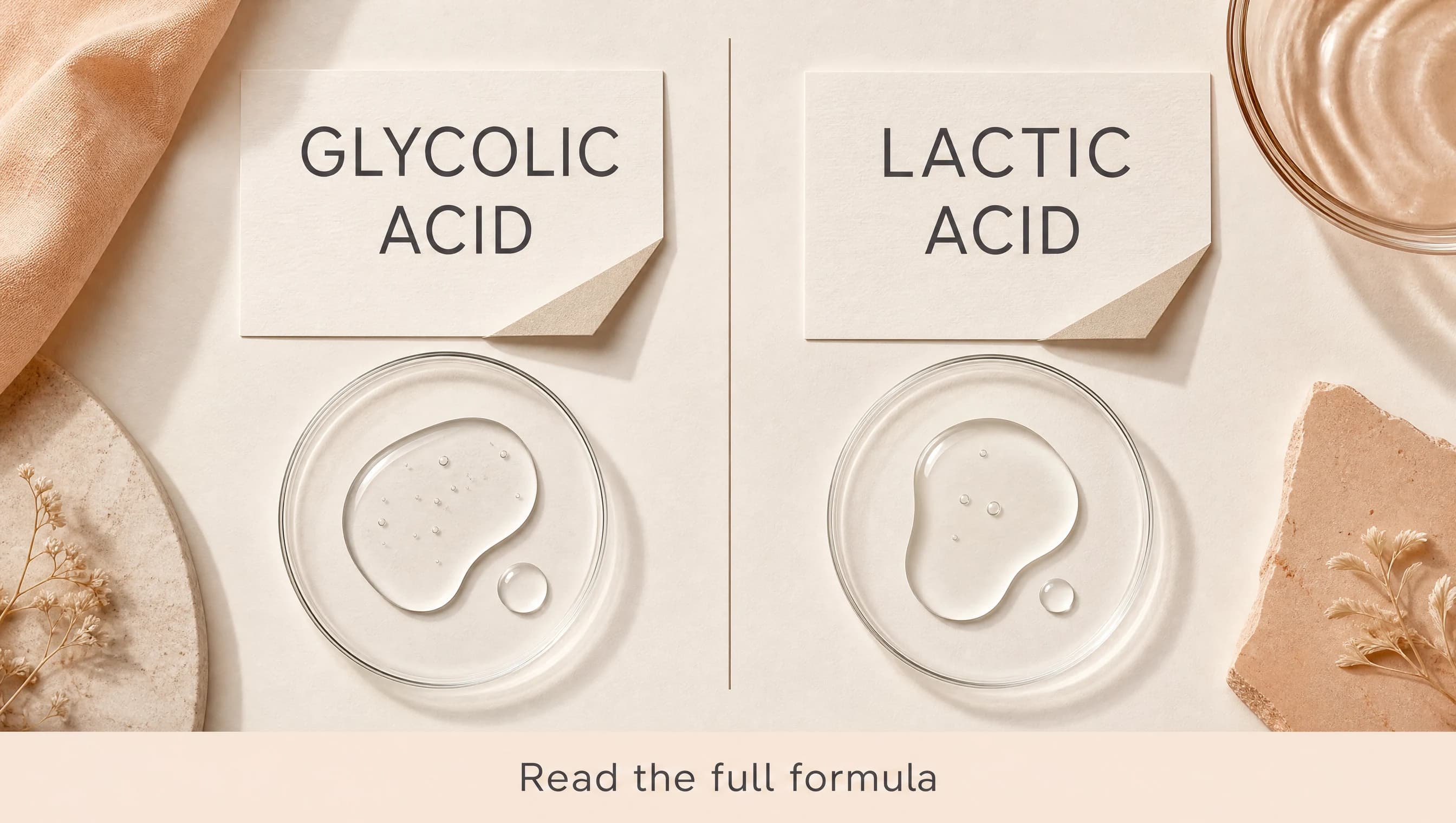
Glycolic acid and lactic acid are both alpha hydroxy acids, or AHAs. For shopping purposes, the useful comparison is between two finished products, not between ingredient names in isolation. Concentration, pH, the rest of the formula and directions all affect how a product is used.
If your current exfoliant is comfortable and meets your goal, there is no automatic need to add the other acid. If your skin is already irritated or peeling, switching acid names is not a sensible way to solve that discomfort.
Start with a product comparison
The Ordinary's current US range provides a concrete example: Glycolic Acid 7% Exfoliating Toner and Lactic Acid 5% + HA. These are two labeled formulas with different acid identities and formats. The brand describes the lactic product as mild; that description is not a guarantee for every user's skin.
| Decision point | Glycolic example | Lactic example |
|---|---|---|
| Exact name | Glycolic Acid 7% Exfoliating Toner | Lactic Acid 5% + HA |
| Disclosed acid percentage | 7% glycolic acid | 5% lactic acid |
| Format | Exfoliating toner | Water-based serum |
| What to compare on your own bottle | Application, exclusions and warnings | Application, exclusions and warnings |
| What the number cannot establish | How it compares with every other AHA formula | A universal guarantee of gentleness |
The FDA explains that AHA exfoliation depends on the acid, concentration, pH and other ingredients. A higher percentage is therefore not a complete product ranking. Nor should you divide the numbers to calculate an imaginary strength conversion.
Match the format to the job
Write the goal in ordinary language: “I want to assess whether this helps the appearance of rough texture” is more useful than “I need more acids.” Then select one formula whose stated use addresses that goal.
For these two examples, handling can decide a shortlist: compare the glycolic toner if you want a pourable liquid step, or the lactic serum if you prefer a serum dispense. If your current acid already meets the intended goal, neither format creates a need for a second AHA. The percentages do not establish an equivalent dose or a winner.
The example glycolic label instructs leave-on use and excludes sensitive, peeling or compromised skin. Read the product you actually own rather than copying instructions from a different acid in the same range.
Review the routine before adding either acid
Make a short inventory of products that already exfoliate or create irritation. Include acid cleansers, masks and scrubs, not just the bottle labeled exfoliant. One extra product can be more than one extra active ingredient.
A worked inventory might read: “Salicylic-acid wash on the shelf; retinoid in use; weekly scrub; proposed lactic serum.” The first decision is which existing optional role the new serum would replace. If no role is being replaced and no separate purpose is clear, pause the purchase. Do not rearrange prescribed treatment to make room.
If you are selecting around sensitivity, read our sensitive-skin exfoliator guide. If the real issue is clogged-looking pores rather than general texture, our blackhead cleanser guide covers a different selection problem. Keep the beginner skin-cycling explanation as a framework to understand scheduling, not a requirement to copy a fixed rotation.
Use instructions as boundaries, not targets
A label that permits daily use does not mean every reader needs to work up to daily application. The AAD advises matching exfoliation frequency to the method and skin response. Keep the first trial simple enough that you can notice discomfort and identify what changed.
AHAs can increase sun sensitivity. Follow the product's sun-protection warning; the FDA discusses protection during use and for a week afterward. Evening application does not remove that concern.
For the broader categories, read AHA versus BHA versus PHA; for introducing exfoliation at a manageable pace, use how often to exfoliate.
Frequently asked questions
Is lactic acid always gentler than glycolic acid?
No. A comparison of ingredient names leaves out concentration, pH and formulation. Compare exact products and do not use “gentle” as permission to continue through irritation.
Should I alternate glycolic and lactic acid?
There is no need to alternate them simply because both are available. Start by identifying whether either product fills a useful gap; adding both makes evaluation harder.
Can I use an acid toner like a hydrating toner?
Treat it according to its exfoliating ingredients and directions. The shared word toner does not make the functions, warnings or suggested use interchangeable.
Sources
FDA: Alpha Hydroxy Acids (fda.gov) — https://www.fda.gov/cosmetics/cosmetic-ingredients/alpha-hydroxy-acids
The Ordinary: Glycolic Acid 7% Exfoliating Toner (theordinary.com) — https://theordinary.com/en-us/glycolic-acid-7-exfoliating-toner-100418.html
The Ordinary: Lactic Acid 5% + HA (theordinary.com) — https://theordinary.com/en-us/lactic-acid-5-ha-exfoliator-100427.html
AAD: How to safely exfoliate at home (aad.org) — https://www.aad.org/public/everyday-care/skin-care-secrets/routine/safely-exfoliate-at-home
Clear guidance, checked before publication.
Solvi articles are structured by our editorial team and reviewed for clarity, consistency, and responsible health language. We update pages when guidance or product information changes.