CeraVe PM vs La Roche-Posay Double Repair: A Guide
Start with the difference you need: CeraVe PM is a facial nighttime lotion; standard Toleriane Double Repair is a facial moisturizer with a different supporting formula. Both reviewed lists include glycerin, niacinamide, dimethicone and ceramide NP. If those shared ingredients are your only criteria, they do not break the tie—use the specific role, known exclusions and the format you prefer.
This guide compares current US CeraVe PM Facial Moisturizing Lotion with the standard, non-SPF Toleriane Double Repair Face Moisturizer. If a listing adds UV, Matte or a sunscreen number, check it separately.
Identify the two formulas precisely
| Label detail | CeraVe PM | Toleriane Double Repair |
|---|---|---|
| Product role | Facial nighttime moisturizer | Facial moisturizer |
| Shared ingredient examples | Glycerin, niacinamide, dimethicone, ceramide NP | Glycerin, niacinamide, dimethicone, ceramide NP |
| Other reviewed-list examples | Ceramides AP and EOP; sodium hyaluronate | Squalane; corn starch |
| Important buying check | PM rather than Daily Lotion or AM | Standard Double Repair rather than UV or Matte |
The CeraVe PM page and Double Repair page establish these label differences. Ingredients can change, so compare the current package with the list you used to make the decision. An older review may accurately describe an older formula and still be the wrong guide to today's bottle.
Start with your reason for changing moisturizer
For an evening-only facial step, PM’s stated role is directly relevant. For a known ingredient exclusion, compare the complete lists: the reviewed PM list includes ceramides AP and EOP and sodium hyaluronate; Double Repair includes squalane and corn starch. A difference matters when it answers your own requirement, not because one ingredient list looks more impressive.
If both products meet your exclusions and either format seems practical, the decision may remain a preference. There is no obligation to find a scientific winner before choosing one. Equally, if your current moisturizer is comfortable and usable, a comparison does not create a need to replace it.
For a broader range of finishes, see our combination-skin moisturizer guide. If reactivity is the central problem, our sensitive-skin moisturizer guide may be more useful than comparing only two recognizable names.
What the shared ingredients cannot settle
Niacinamide on both lists does not tell you the concentration, delivery, or effect on a particular concern. Ceramide names do not establish a ranking between finished products. A formula with more individually named ceramides is not automatically the better purchase.
Avoid translating moisturizing language into claims about treating acne, rosacea or a diagnosed skin condition. If you are using a prescription, the prescriber's directions remain the relevant instructions for that treatment. This shopping comparison cannot establish a substitute.
Use a practical value calculation
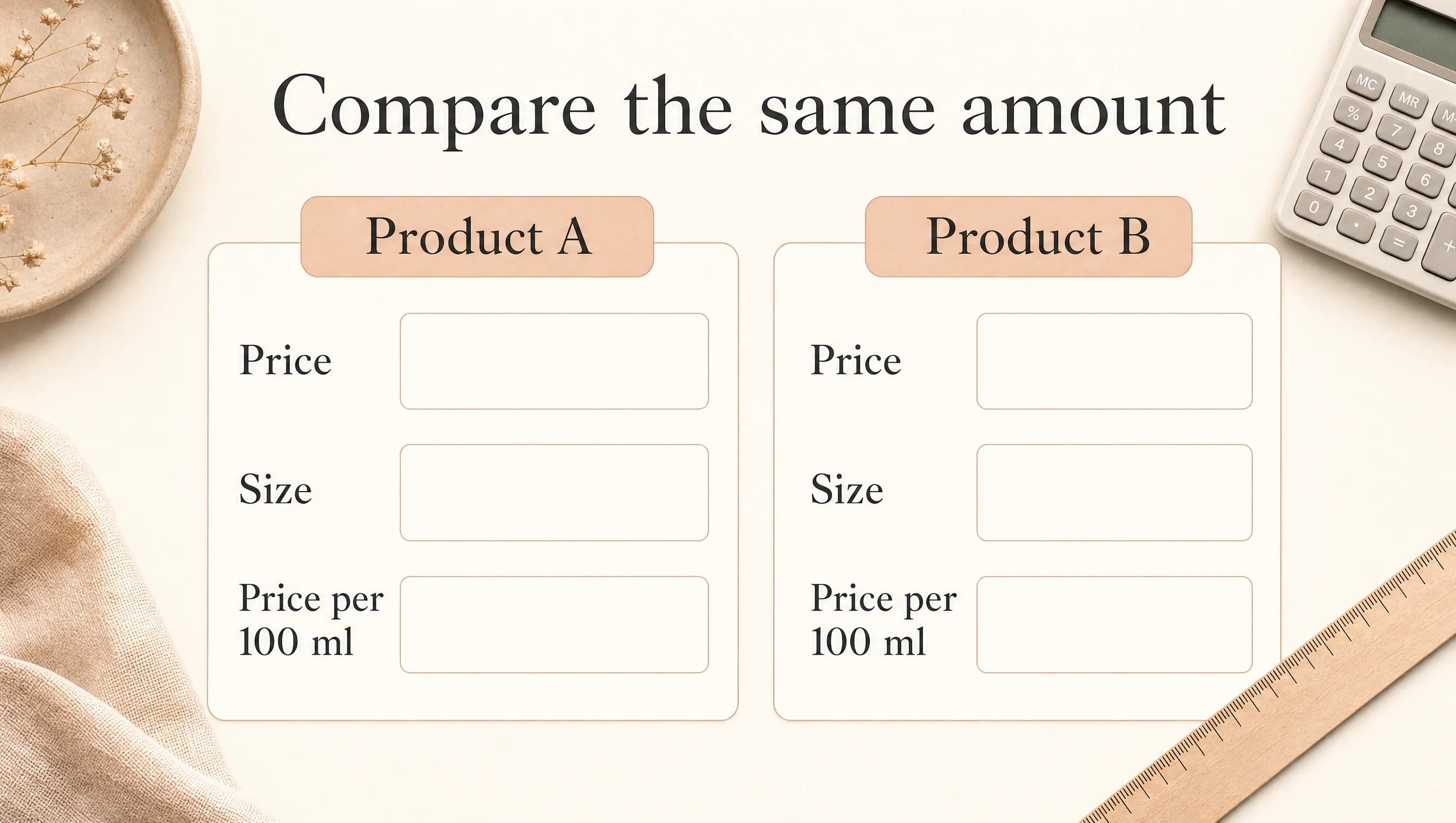
To compare price fairly, select the actual package sizes available to you and record each checkout price. Divide price by the same unit of volume, then multiply by 100 if you want a cost per 100 mL. Do not use a retailer's thumbnail image to infer the size.
For illustration only, a $15 bottle containing 75 mL costs $20 per 100 mL; an $18 bottle containing 100 mL costs $18 per 100 mL. The second is cheaper by volume but costs more at checkout. These are fictional numbers, not current prices for either moisturizer.
If both formulas meet the practical requirements and neither has a relevant exclusion, preference can settle the choice. Keep a comfortable current moisturizer unless the replacement offers a change you can name.
Keep a new-product trial interpretable
The AAD advises checking a new product on a small area before regular use. A home check cannot provide a clinical allergy diagnosis. If a product triggers a reaction, stop using it rather than treating discomfort as proof that the formula is working.
Keep your initial question simple: do you prefer the new formula's practical use in the role you intended? Record other changes, such as a new cleanser, so that they do not disappear from the explanation. Our moisturizer guide for dehydrated-feeling skin provides a wider view when the issue is not just the current bottle.
If the CeraVe names are still confusing, compare PM with Daily Moisturizing Lotion. If you are considering a richer La Roche-Posay body-and-face option, read the separate Toleriane versus Lipikar comparison rather than assuming that Double Repair represents the whole brand.
Frequently asked questions
Which one has more niacinamide?
The reviewed ingredient lists do not establish a reliable percentage comparison. Ingredient presence alone is not enough to answer that question.
Is Double Repair the same as Double Repair UV?
No. The UV name identifies a separate sunscreen-containing product. Check its own complete label rather than transferring this comparison to it.
Does CeraVe PM replace a daytime sunscreen?
No. This article covers the PM moisturizer, whose reviewed directions specify nighttime use. A moisturizing step and labeled sun protection serve different purposes.
Sources
CeraVe: PM Facial Moisturizing Lotion (cerave.com) — https://www.cerave.com/en-us/skincare/moisturizers/pm-facial-moisturizing-lotion
La Roche-Posay: Toleriane Double Repair Face Moisturizer (laroche-posay.us) — https://www.laroche-posay.us/our-products/face/face-moisturizer/toleriane-double-repair-face-moisturizer-3337875545792.html
American Academy of Dermatology: Testing skin-care products (aad.org) — https://www.aad.org/public/everyday-care/skin-care-secrets/prevent-skin-problems/test-skin-care-products/
Clear guidance, checked before publication.
Solvi articles are structured by our editorial team and reviewed for clarity, consistency, and responsible health language. We update pages when guidance or product information changes.