Peptides vs Retinol: Compare the Product and the Evidence
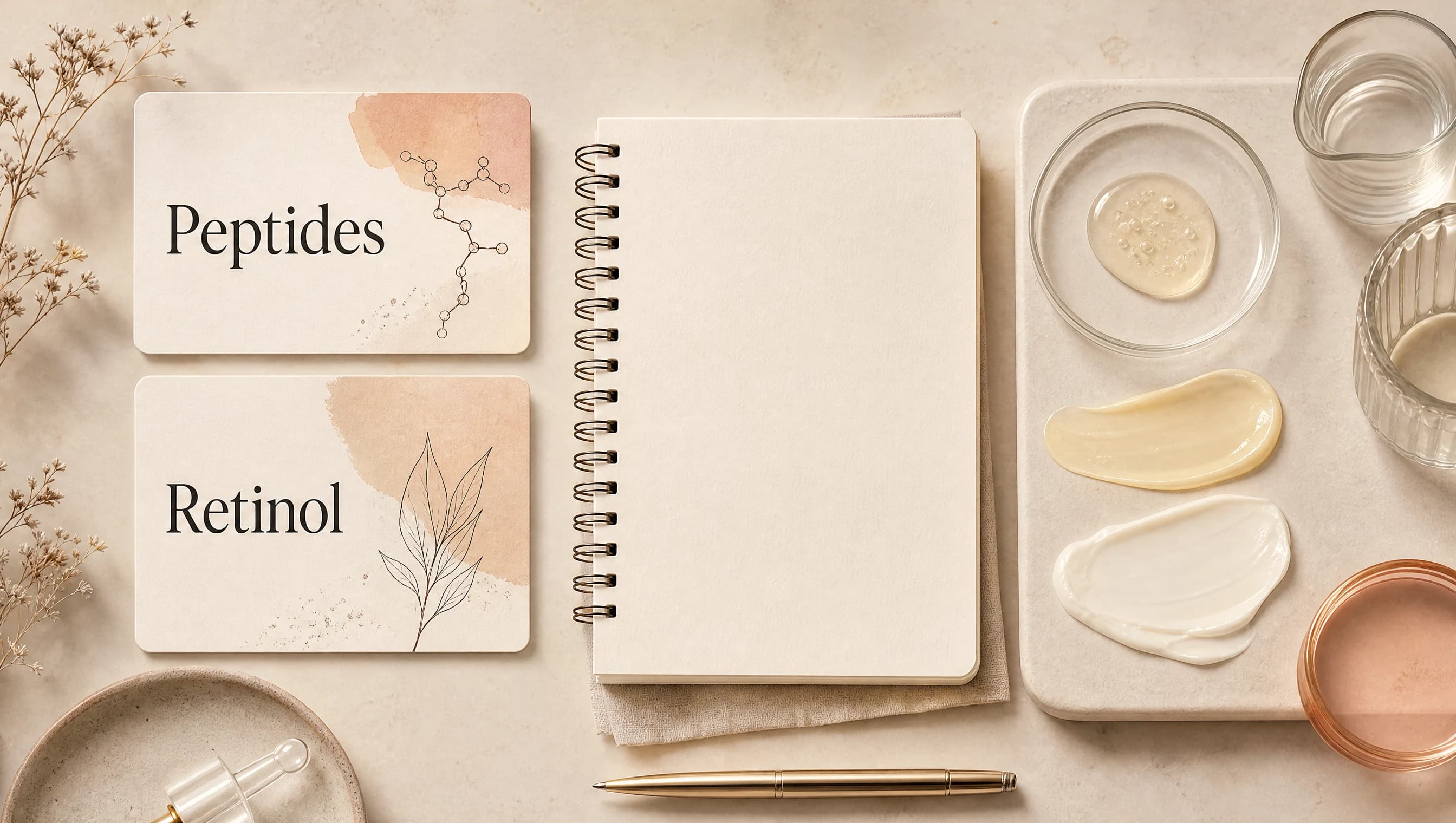
For routine fit, the first useful question is whether you already use a retinoid you want to keep. A new peptide serum may have restrictions that affect that choice: The Ordinary’s Copper Peptides 1% example lists retinoids under its do-not-use-with guidance. If you are deciding between the categories for visible results, the ingredient names alone do not supply a winner; the exact formula and outcome evidence matter.
For a practical decision, ask which exact product earns a place in your routine. A peptide label alone does not promise retinol-like results, and the word “gentle” does not establish that a formula will suit you.
Compare a product with a product
“Peptides” covers many formulas. Even two serums from The Ordinary have a meaningful difference: Multi-Peptide + HA Serum and Multi-Peptide + Copper Peptides 1% Serum have different compatibility guidance. A broad ingredient category would miss that distinction.
| Your current situation | Practical decision | Evidence boundary |
|---|---|---|
| You already use a retinoid and want to keep it | Check a proposed peptide serum’s exact restrictions before buying | The reviewed copper serum has a relevant retinoid restriction |
| You want an optional serum but have no specific gap | Define one cosmetic goal first; keeping the current routine is an option | A new ingredient category is not a required upgrade |
| You are avoiding retinoids for a medical reason | Discuss suitable care with your clinician | Peptide labeling does not establish pregnancy safety or universal tolerance |
| You want proof that one product improves a specific outcome more | Look for a relevant finished-product comparison | Separate product claims cannot be ranked as a head-to-head result |
The AAD identifies retinol as a type of retinoid used for the appearance of tone, pigmentation and texture. That context is useful, but it does not establish that every retinol bottle outperforms every peptide serum.
Read the evidence behind the appealing phrase
A product page may say “firmer-looking skin,” “smooths fine lines” or “supports youthful-looking skin.” These are different statements from demonstrating superiority over another treatment.
Use three questions to interpret a claim:
- Was the finished product studied, or only an ingredient discussed?
- Was there a relevant comparison group, or only a before-and-after observation?
- Does the reported outcome match the one you care about?
If no relevant comparison is supplied, use the facts you can verify—product restrictions, format and the existing step you would keep or replace. Keep the efficacy question open rather than treating price or a technical name as the answer.
Routine compatibility can decide the purchase
The Ordinary's current Copper Peptides 1% serum page lists retinoids among products not to use with it. The Multi-Peptide + HA page has its own restrictions, but does not list retinoids in that same section. Both require a closer look than “peptides go with everything.”
Our detailed Multi-Peptide + HA versus Copper Peptides comparison covers that actual bottle-to-bottle choice. Follow the current instructions for the products you own; the difference above is not a universal rule for every peptide brand.
If you already use a retinol product comfortably and value that step, a new serum should not create a complicated schedule without a clear reason. If you do not want to use retinol, buying a peptide product remains a separate choice rather than a guaranteed replacement.
Suitability comes before an anti-aging shopping list
The AAD advises against retinoid use during pregnancy and highlights reasons some people should seek advice before choosing these products. Avoid translating that into “peptides are therefore safe for everyone.” Suitability is a question about the complete product and your circumstances.
Our retinol guide for mature skin focuses on selecting that type of product. The serum guide for sensitive skin helps keep comfort and formula selection visible when shopping across categories.
An additional serum should be a considered choice rather than a requirement for completing a collection.
Make room by removing a duplicate role
Before purchasing, list what your current products are supposed to do. If several already occupy the same optional serum step, choose one product to assess rather than adding another similar promise on top.
Our aging-skin routine guide considers the broader arrangement. If you are also seeing another ingredient described as a retinol alternative, the bakuchiol-versus-retinol comparison addresses that separate claim.
Frequently asked questions
Are peptides as effective as retinol?
That question is too broad without named products, a specific outcome and relevant comparative evidence. Marketing both for signs of aging does not make their effects equivalent.
Can I use a peptide serum with retinol?
Check the exact formulas. The current Copper Peptides serum discussed here specifically lists retinoids under its compatibility restrictions.
Are peptides automatically better for sensitive skin?
No category guarantees tolerance. Consider the complete formula, instructions and your history rather than assuming a peptide label settles the decision.
Sources
The Ordinary: Multi-Peptide + HA Serum (theordinary.com) — https://theordinary.com/en-us/multi-peptide-ha-serum-100613.html
The Ordinary: Multi-Peptide + Copper Peptides 1% Serum (theordinary.com) — https://theordinary.com/en-us/multi-peptide-copper-peptides-1-serum-100625.html
American Academy of Dermatology: retinoids and retinol (aad.org) — https://www.aad.org/public/everyday-care/skin-care-secrets/anti-aging/retinoid-retinol
Clear guidance, checked before publication.
Solvi articles are structured by our editorial team and reviewed for clarity, consistency, and responsible health language. We update pages when guidance or product information changes.