Retinol vs Retinyl Palmitate: What Labels Tell You
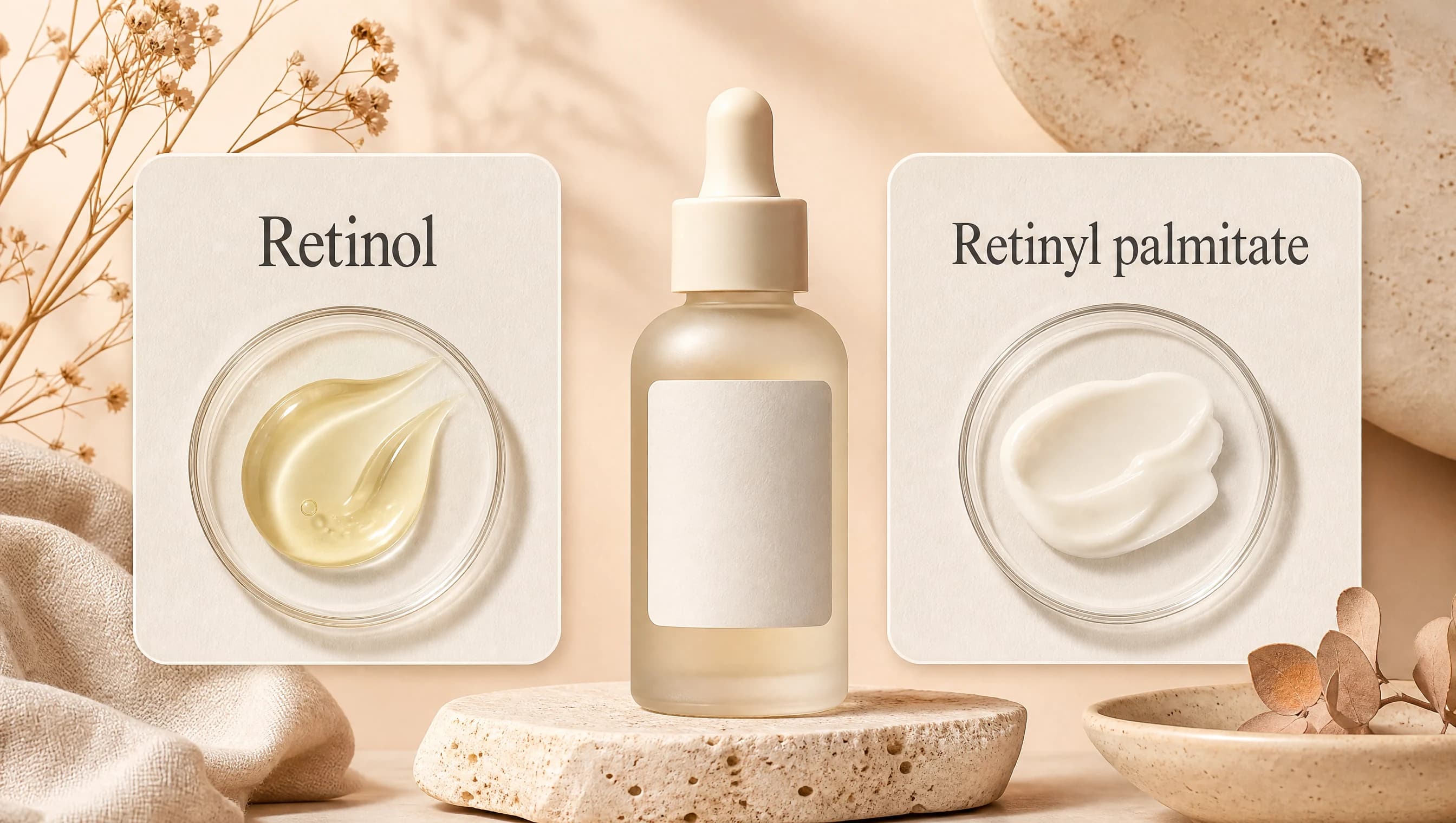
Retinol and retinyl palmitate are related vitamin A ingredients, but they are not interchangeable names. Retinyl palmitate is an ester of retinol. That distinction helps identify a cosmetic ingredient; it does not provide a reliable conversion chart for the strength, tolerance or results of two finished products.
Choose by the product's intended role, complete formula and evidence. A retinyl-palmitate label does not automatically establish that a product is harmless, and a retinol label does not make a cosmetic interchangeable with a prescribed retinoid medicine.
Identify the ingredient accurately
The FDA substance registry identifies retinyl palmitate as vitamin A palmitate. The registry also makes clear that an identifier is not regulatory approval. It is a way to establish substance identity.
| Term | What it tells you | What it leaves unanswered |
|---|---|---|
| Retinol | A particular vitamin A ingredient | The complete formula's concentration, stability and result |
| Retinyl palmitate | A related retinyl ester | Whether a product is suitable for your concern |
| Retinoid | The broader vitamin A-related category | Which exact ingredient or medicine is present |
| Retinol complex | A formulation or marketing description | The amount of pure retinol unless separately disclosed |
For another distinct comparison within this family, see retinol versus retinal. Small spelling changes can identify different ingredients, so copy the label exactly when comparing products.
Do not turn metabolism into a shopping equation
A primary laboratory study investigated conversion of retinyl palmitate to retinol during skin absorption. That research helps explain the relationship between the ingredients. It was not a head-to-head trial showing that a particular retail cream equals a specific retinol serum.
A biochemical pathway cannot account for every difference in formulation, packaging, amount applied or personal response. Avoid statements such as “this percentage equals that percentage” unless a relevant comparison actually supports them.
Read the complete label and the actual claim

The FDA explains that cosmetic ingredients generally appear in descending order of predominance. That general ordering is not a full concentration disclosure or a measure of effectiveness.
Write down what the manufacturer actually says the product is intended to do. Then separate a measured result for that formula from a broad description of an ingredient. If the evidence concerns a different product, it cannot simply be transferred to the bottle you are considering.
Our retinol guide for mature skin can help frame product-format questions. For uneven-tone concerns, our retinol and dark-spots guide offers related context without making every vitamin A cosmetic equivalent to a targeted medical treatment.
Decide whether the category fits your routine
The AAD's retinoid guide distinguishes cosmetic retinol from retinoid medicines and emphasizes individual suitability. Retinoids can irritate, and the AAD advises avoiding them during pregnancy. Ask a clinician about use when planning pregnancy or when the routine is complicated by a skin condition.
If your skin is already persistently irritated, do not use a supposedly milder name as a shortcut around that problem. Professional advice may be more useful than moving between products based on a guessed strength ladder.
Our guide to whether retinol is needed in your 20s focuses on the concern rather than a compulsory starting age.
Compare two products with a short worksheet
Use a two-line decoding note rather than a strength ladder. Example: “Bottle A lists Retinol; no percentage disclosed. Bottle B lists Retinyl Palmitate; no percentage disclosed.” You have identified different ingredients, but you still cannot calculate an equivalent dose or rank the finished formulas. Next, compare their intended purpose, directions and relevant product evidence. This is a fictional label-reading exercise, not two tested retail products.
If moisturizer order is the remaining issue, read our retinol sandwich-method guide while preserving your exact product or prescriber instructions. A technique cannot make an unsuitable treatment suitable or establish that two formulas are equivalent.
Frequently asked questions
Is retinyl palmitate the same as retinol?
No. It is a related ester with a different ingredient identity. Use the exact label name when comparing formulas.
Can I calculate equivalent percentages?
Not from the ingredient names alone. A metabolism diagram does not establish matching performance between finished products.
Does a lower position on the list mean the product cannot work?
No. List position alone is not a full concentration or efficacy assessment. Look for evidence about the specific formula.
Sources
FDA substance registry: Vitamin A palmitate (precision.fda.gov) — https://precision.fda.gov/uniisearch/srs/unii/1d1k0n0vvc
Boehnlein et al.: Retinyl palmitate metabolism in skin (pubmed.ncbi.nlm.nih.gov) — https://pubmed.ncbi.nlm.nih.gov/7971717/
FDA: Cosmetic ingredient names (fda.gov) — https://www.fda.gov/cosmetics/cosmetics-labeling/cosmetic-ingredient-names
American Academy of Dermatology: Retinoid or retinol? (aad.org) — https://www.aad.org/public/everyday-care/skin-care-secrets/anti-aging/retinoid-retinol/
Clear guidance, checked before publication.
Solvi articles are structured by our editorial team and reviewed for clarity, consistency, and responsible health language. We update pages when guidance or product information changes.