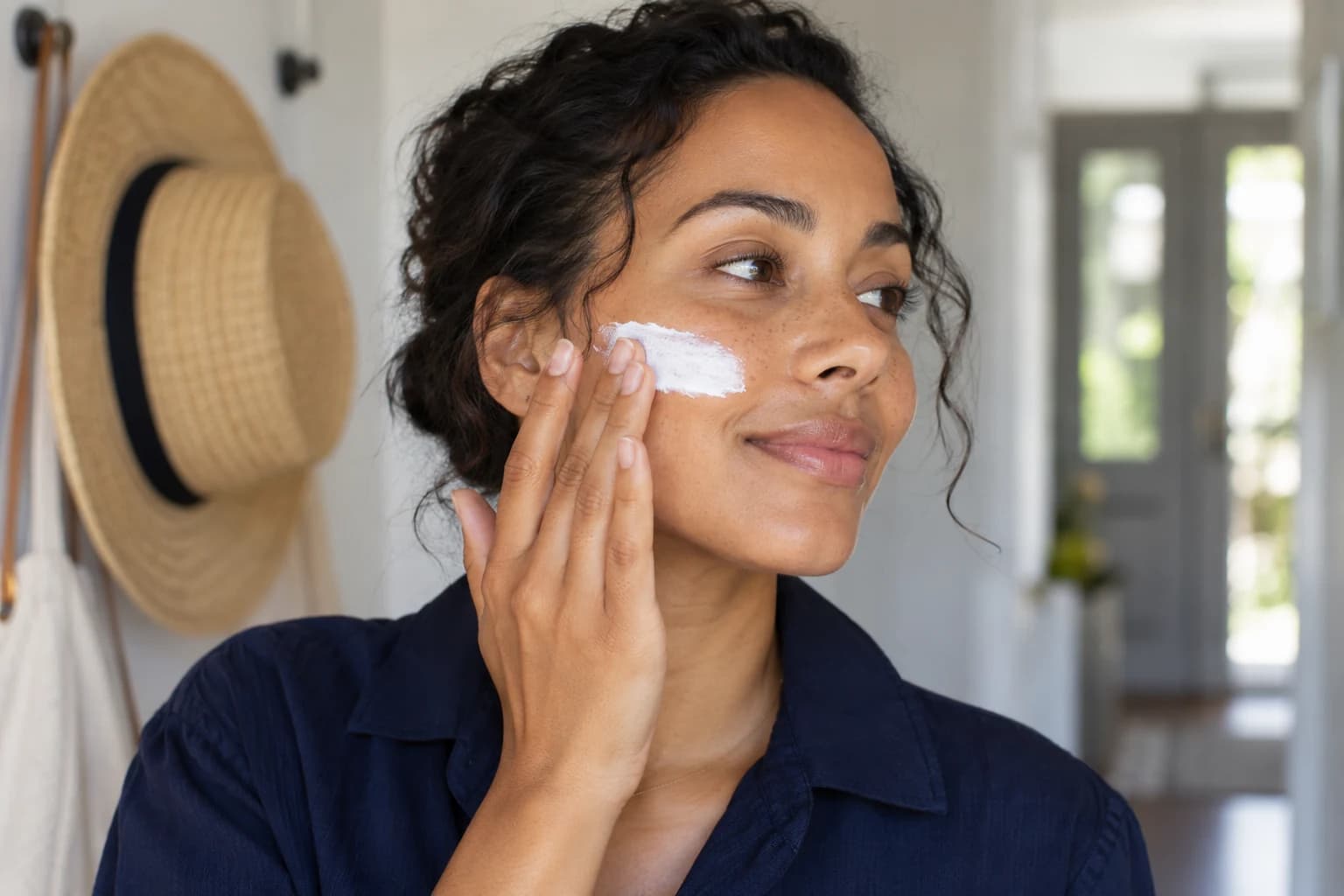
The Normal Skincare Routine That Keeps Things Simple—and Flexible



A normal skincare routine is uncomplicated: cleanse as needed, use a treatment only when it serves a goal, moisturize, and wear broad-spectrum SPF 30 or higher in the morning. At night, cleanse, apply your chosen treatment if you use one, then seal in comfort with moisturizer.
The useful meaning of “normal” here is not flawless or fixed. It is skin that generally feels balanced enough to prioritize maintenance over a crowded cabinet—so the smartest routine is one with a dependable core and a few purposeful switches, not a ten-step production.
The normal-skin routine edited down
Think of the routine as a wardrobe of dependable basics. A gentle cleanser clears away what you do not want to sleep in or layer over; a moisturizer supports a comfortable finish; sunscreen is the daytime protective step. Serums and exfoliants belong only when you have a specific reason to use them.
For many people, three to four products in the morning and two to three at night is enough. That restraint has a practical upside: when a formula feels too rich, too drying, or simply unnecessary, it is easier to identify the mismatch and adjust.
| Step | Morning job | Evening job | Format to consider |
|---|---|---|---|
| Cleanse | Refresh skin if needed | Remove the day | Cream, lotion, gel, or low-foam wash |
| Treat | Optional antioxidant vitamin C | Optional retinoid or other targeted active | Thin serum, gel, or lotion |
| Moisturize | Add comfortable hydration | Cushion and soften the finish | Gel-cream, lotion, or cream |
| Protect | Broad-spectrum SPF 30+ | Not needed | Fluid, lotion, cream, or stick for touch-ups |
What belongs in the core
- A gentle cleanser that leaves skin feeling clean rather than tight or squeaky.
- A moisturizer in a texture you will actually reach for daily.
- A broad-spectrum sunscreen with SPF 30 or higher for daytime.
- One optional treatment chosen for a single, clear goal—not every goal at once.
The layering rule that prevents guesswork
Move from cleansing to treatment to moisturizer, then finish with sunscreen in the morning. In practical terms, thinner water-based serums usually sit comfortably before creams, while sunscreen is the final skincare layer before makeup. Let each layer settle briefly rather than trying to create a long waiting ritual.
If your skin is content without a morning cleanse, a rinse or going straight to moisturizer and sunscreen may be a reasonable streamlined option. If you wake up feeling oily or prefer the reset of cleansing, use your gentle wash. The point is an unfussy baseline you can sustain.
Your morning routine in order

Morning skincare should feel light enough to disappear under the rest of your day. Choose textures according to your preferred finish: a clear gel cleanser and gel-cream moisturizer can feel airy, while a lotion cleanser and creamier SPF suit someone who likes more cushion.
- Cleanse gently, if needed. Massage a mild cleanser over damp skin and rinse with lukewarm water. If you do not need a full cleanse in the morning, keep this step minimal rather than adding a stronger wash.
- Apply an antioxidant vitamin C serum, if it fits your routine. This is optional, not a mandatory badge of a “good” routine. Pick a thin serum format if you prefer quick layering before moisturizer and sunscreen.
- Moisturize. Use a gel-cream for a weightless, fresh finish; use a lotion for a balanced middle ground; choose a cream when you prefer a plusher feel.
- Apply broad-spectrum SPF 30 or higher. Make this your final skincare step. A sunscreen you enjoy wearing—fluid, lotion, cream, or another acceptable format—is more useful than one that stays on the shelf.
Choosing the daytime texture
| If you want... | Look toward... | Tradeoff to expect |
|---|---|---|
| A nearly weightless finish | Gel cleanser, fluid sunscreen, gel-cream moisturizer | May feel less cushioning to someone who enjoys richer layers |
| A classic, easy middle | Lotion cleanser, lightweight lotion moisturizer, lotion SPF | Can be less matte than a gel-focused lineup |
| A softer, more enveloping feel | Cream cleanser, cream moisturizer, cream SPF | May feel more substantial under makeup or in warm weather |
The best daytime finish is personal, not moral. If makeup tends to pill over several layers, simplify first: use the smallest number of compatible products, keep textures light, and let sunscreen remain the non-negotiable final step.
Your evening routine in order

Night is where a normal skincare routine can become more customized, but it does not need to become complicated. Your most reliable framework is cleanse, treat, moisturize. If you are not using a treatment that evening, go straight from cleansing to moisturizer.
- Cleanse away sunscreen, makeup, and the day. Use the same gentle cleanser that works in the morning, or reserve cleansing for nighttime if that suits your skin and habits.
- Use one targeted treatment, if desired. A retinoid is a common nighttime option for an anti-aging goal; a BHA is a possible choice for oily or combination-leaning concerns. Begin with one active rather than stacking several unfamiliar products.
- Apply moisturizer. A cream can give the finish a more buffered, comforting feel at night, while a lotion or gel-cream remains appropriate if that is what your skin prefers.
- Stop there. The elegant part of a nightly routine is knowing when it is complete. Extra layers are optional, not proof of efficacy.
How to introduce treatment nights
Start deliberately, because tolerance is a better guide than enthusiasm. Patch test new products, introduce one active at a time, and build frequency gradually according to how your skin responds and the product directions.
- Choose retinoid nights when your goal is a nighttime anti-aging step.
- Choose BHA nights when oiliness or a combination-skin pattern is your main focus.
- Choose recovery nights—cleanse and moisturize only—when you want to keep the routine quiet.
- Avoid turning every evening into an active night just because the products can technically be layered.
Customize by goal, not by trend
A normal routine works best as a decision tree: preserve the basics, name one priority, then add one compatible product format. This approach makes shopping clearer and gives your skin a calmer learning curve.
If your goal is maintenance
Stay with the essential lineup: gentle cleanser, moisturizer, and broad-spectrum SPF 30 or higher. An optional antioxidant serum can fit in the morning if you want one additional treatment layer, but it is not required for a complete routine.
If your goal is a nighttime anti-aging step
Add a retinoid at night, keeping the rest of the routine gentle and moisturizing. Introduce it gradually and do not debut it alongside several other new actives; that makes it difficult to tell what your skin tolerates.
If your goal is oilier or combination-leaning areas
A BHA may be the more targeted optional add-on. Look for a format you can place precisely—such as a thin liquid, serum, or gel—and avoid assuming that the rest of the face needs the same intensity as the T-zone.
If your goal is a more comfortable feel
Adjust the moisturizer before rebuilding the whole routine. A gel-cream, lotion, and cream can all occupy the same step; the difference is largely the finish and cushion you prefer. You may also choose a gentler cleanser texture if washing leaves your skin feeling stripped.
How to shop the routine without overbuying

Commercial skincare is full of “complete system” language, but a good routine is built step by step. Shop by formula role, texture, and likelihood of repeat use—not by the pressure to purchase a matching collection.
A practical cart checklist
- Start with gaps. If you already have a gentle cleanser and a moisturizer you like, sunscreen may be the only necessary purchase.
- Match texture to your real life. A dewy cream may be ideal at bedtime yet feel too substantial beneath daytime makeup; there is no rule saying AM and PM moisturizers must match.
- Buy one new active at a time. This is the clearest way to patch test, introduce gradually, and learn whether the formula fits.
- Look for daily usability. Consider scent preference, pump versus tube, travel practicality, and whether the formula layers without making your morning feel fussy.
- Keep sunscreen distinct. Its role is protection, so broad-spectrum SPF 30 or higher should be clear in your selection criteria.
What to skip at first
You do not need to begin with every category at once. Hold off on these additions until your core routine feels easy and your goal is specific:
- Multiple exfoliating products used in the same routine.
- A new retinoid and a new BHA introduced in the same week.
- A richer moisturizer solely because it seems more “serious,” if you consistently prefer a light gel-cream.
- A complicated AM routine that makes you less likely to apply sunscreen.
The value calculation is refreshingly simple: use up a core product that works, then upgrade only the step that has a real job to do. A routine with a pleasant cleanser, reliable moisturizer, and sunscreen you will apply daily generally offers more practical value than a drawer of half-used experiments.
The one-week reset for an overcomplicated shelf
If your bathroom counter has become a testing lab, reset to the foundation before adding anything new. This is not about declaring products “bad”; it is about creating enough space to notice what earns a permanent place.
- For several days, use only a gentle cleanser, moisturizer, and daytime broad-spectrum SPF 30 or higher. Keep the steps familiar and comfortable.
- Choose one goal. Maintenance, a nighttime anti-aging step, or oilier/combination-leaning areas are distinct paths.
- Add one treatment in its appropriate slot. Vitamin C fits as an optional morning antioxidant; retinoid or BHA options belong in the evening framework described above.
- Patch test and introduce gradually. Do not make another new active part of the routine until you know how the first one fits.
A normal skincare routine should look quietly tailored, not relentlessly maximal. The most polished version is the one whose order you can remember without a mirror-side cheat sheet: cleanse, treat if needed, moisturize, and protect by day.
Related reading
- Good Morning Skincare Routine: Simple Steps
- Skin Cycling Routine for Beginners: 4-Night Plan
- Products for Combination Skin: Shopping Guide
Frequently asked questions
Do I need cleanser in the morning if I have normal skin?
Not necessarily. A gentle cleanse can be useful if you prefer it or wake up feeling oily, but some people keep mornings lighter and focus on moisturizer and sunscreen. Keep nighttime cleansing as the dependable reset after sunscreen and the day.
What is the best skincare routine order at night?
Use cleanse, targeted treatment if you use one, then moisturizer. Retinoid or BHA options fit into the treatment step; if it is a recovery night, cleanse and moisturize are enough.
Can I use vitamin C, a retinoid, and BHA in one routine?
They do not all need to appear at once. A simpler plan is optional vitamin C in the morning and one nighttime active introduced gradually, with sunscreen every day and attention to tolerance.
What should I buy first for a normal skincare routine?
Prioritize a gentle cleanser, moisturizer, and broad-spectrum SPF 30 or higher. Add a treatment only once you can name the goal it serves and are ready to introduce it one at a time.
Sources
- American Academy of Dermatology (AAD)
- Garnier: The Perfect Skin Care Routine Order
- Allure: Skin Care
Clear guidance, checked before publication.
Solvi articles are structured by our editorial team and reviewed for clarity, consistency, and responsible health language. We update pages when guidance or product information changes.

Maya Bennett
Senior Beauty Editor. Maya is the skincare obsessive who turns big beauty questions into clear, grounded guidance. She is especially interested in routines that respect real skin, real schedules, and realistic budgets.