The Best Glasses Shapes for a Heart-Shaped Face: A Smart, Stylish Frame Guide



The best glasses shapes for a heart-shaped face are usually aviators, oval or round frames, softly rounded cat-eyes, and styles with a little more visual weight below the eye line. They help balance a wider forehead with a narrower, more pointed chin without turning frame shopping into a rigid set of rules.
Think of face shape as a useful first filter, then let fit do the final editing. A frame that sits neatly at the bridge, reaches approximately to the temples, and feels good after a few minutes will almost always look more polished than a theoretically “perfect” shape that pinches or slides.
The fast rule for heart-shaped faces
A heart-shaped face is often described as broader through the forehead and cheekbones, then narrower through the jaw and chin. The most flattering frames tend to redirect attention toward the middle and lower part of the face, rather than adding a dense horizontal line across the brow.
That is why a delicate metal aviator, a softly curved oval, or a rounded acetate frame can be such an easy yes. Their curves soften the visual point at the chin, while their lower lens area gives the face a more even sense of proportion.
Your quickest shopping filter
Use these three checkpoints before you get attached to a color or a trend:
- Choose a frame that is close to your face width, with the outer edges landing around—not dramatically beyond—your temples.
- Favor a silhouette with soft curves or a lower rim that has a touch more presence than the brow area.
- Be cautious with extremely tiny, narrow lenses, which can make the forehead appear comparatively wider.
Start with proportion, not labels
The phrase “heart-shaped face” can suggest one universal solution. In practice, two people with a similar forehead-and-chin outline may need very different glasses: one may need a wider eye size, while another may need a narrower bridge or lower-set temples. Start with the overall architecture of the frame before deciding whether it is officially round, cat-eye, or aviator.
Frame width is the most useful first measurement to eyeball. When the frame ends far inside the temples, it can look undersized; when it extends far beyond them, the top of the face can take on more visual width. Neither is automatically wrong for fashion, but a near-temple alignment is the easiest route to everyday harmony.
| What to assess | A balanced direction for a heart-shaped face | What can feel less balanced |
|---|---|---|
| Overall width | Frame edges sit near the temples | A very narrow frame that leaves lots of face visible at the sides |
| Visual weight | Curved or subtly fuller lower half | A heavy, straight brow with a very fine lower rim |
| Lens shape | Oval, round, teardrop, or softened angles | Extremely shallow, narrow lenses |
| Temple placement | A position that feels stable and natural | High-set temples that do not sit comfortably on your face |
| Bridge fit | Secure, pressure-free contact at your nose bridge | Sliding, pinching, or a frame that rests on the cheeks |
The bridge deserves an actual try-on, rather than a guess based on face shape. It should feel secure without digging in or slipping; if it does not, ask an optician about another bridge construction, nose-pad setup, or size. A low-bridge aviator can be worth exploring when that particular fit is helpful.
The frame shapes that balance a heart-shaped face

The best category is the one that gives you the balance you want while matching how you actually dress. Below, the silhouettes have different personalities—from airy and minimal to graphic and polished—but share a tendency to soften a tapered lower face or bring visual interest below the forehead.
Aviators
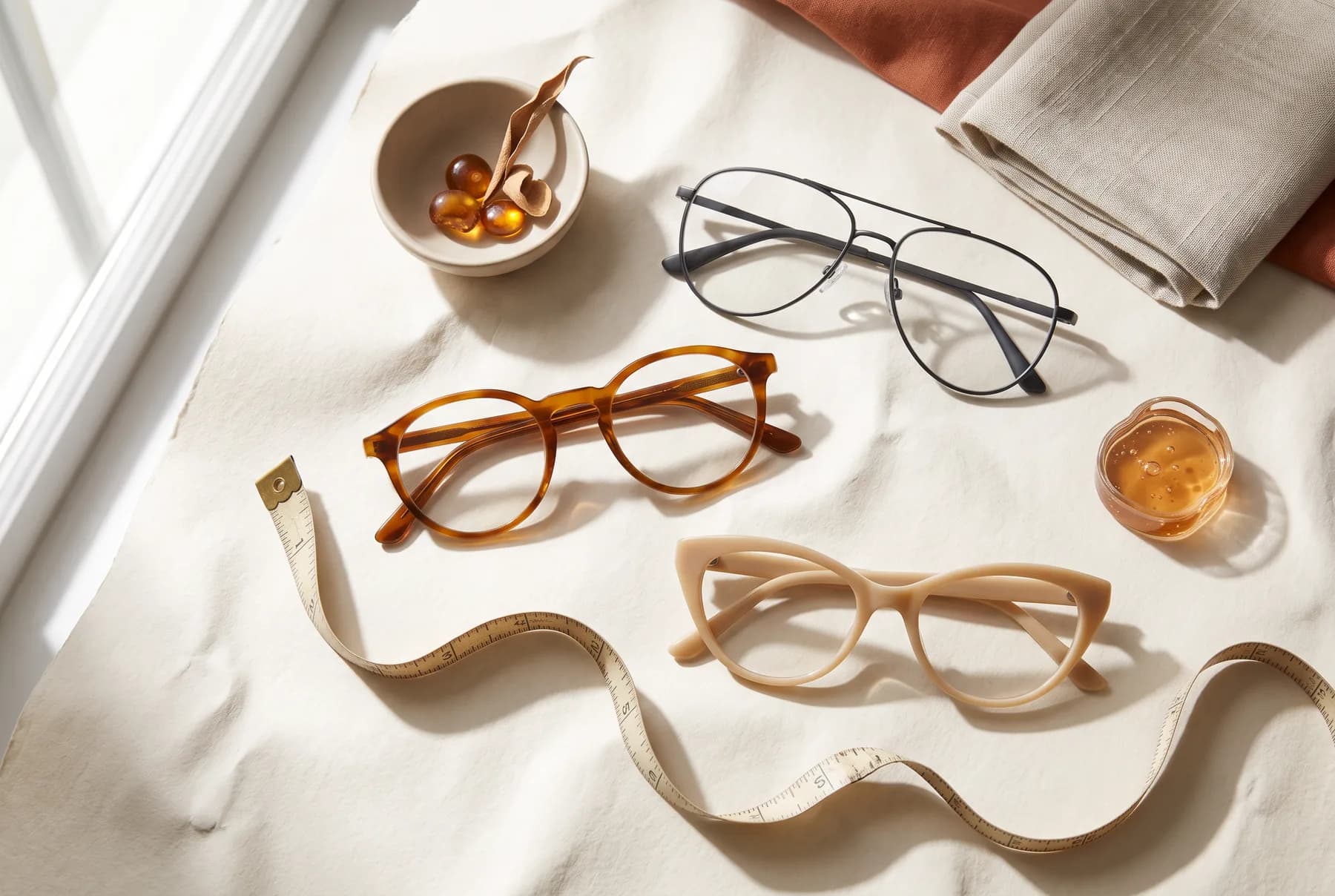
Aviators are the reliable choice when you want a little downward movement without visual bulk. The teardrop lens shape broadens through the lower area, and a thin metal rim keeps the upper face from feeling overly outlined. For everyday optical glasses, look for a less oversized lens and a bridge that feels stable; for sunglasses, a larger lens can offer a more dramatic finish.
Rounded cat-eyes
A cat-eye does not have to be sharp, narrow, or aggressively upswept. A version with softened upper corners, a rounded lens, and some substance at the lower rim can look elegant on a heart-shaped face. It is a strong option for someone who likes a defined, dressed-up frame but wants to avoid a hard line emphasizing the forehead.
Oval frames
Ovals are quiet workhorses. Their horizontal curve can temper the contrast between a broad upper face and a narrow chin, and they move easily from office to weekend. In acetate, an oval has a tactile, substantial look; in fine metal, it reads cleaner and lighter.
Round frames
Round frames provide the most visible contrast to a pointed chin. Choose a size that does not look tiny on the face, and consider a slightly wider lower rim if you like a more grounded effect. A true circle looks artsier; a gently rounded panto shape, with a subtly flattened top, often feels more classic.
Bottom-weighted frames
This is less a single shape than a visual strategy. Look for frames that are fuller below the eye line, whether through a deeper lens, a slightly thicker lower rim, or a softly weighted acetate construction. The effect can be subtle—enough to balance without making your glasses feel like a costume.
Choose the material and lens size for your life
Once you have a favorable shape, materials determine how it wears. Acetate has a smooth, solid presence and gives color, translucency, and rim thickness more impact. Metal often feels visually lighter, especially in gold, silver, or muted gunmetal, while mixed-material frames can give you a defined brow without a fully top-heavy effect.
For an everyday optical pair
An everyday pair has to work with your expressions, hair, makeup, and screen-time habits—not just a dressing-room pose. Consider these practical directions:
- Choose a medium lens depth if you want enough coverage without an oversized look.
- Pick translucent amber, warm brown, soft taupe, or a fine metal finish when you want the frame to blend easily with changing outfits.
- Choose a rounded cat-eye or oval acetate when you want glasses to function as a noticeable accessory.
- Ask for an adjustment if the frame shifts when you smile, because cheek contact can become distracting over a full day.
For sunglasses
Sunglasses allow for more scale and personality. Aviators are especially useful here because their lower lens shape has presence without relying on a thick brow. A softly rounded oversized oval can also work beautifully, provided the outer edges do not overwhelm the temple line.
For a more directional look
You do not need to avoid every brow-forward frame forever. If you love a bolder cat-eye or a statement color, soften one other element: choose rounded corners, a moderate width, a deeper lens, or lighter material. The goal is not to erase your natural face shape; it is to make the frame look intentional.
How to shop without overthinking your face shape

Use the mirror as a fit tool, not a pass-or-fail test. Bring the frame to eye level, look straight ahead, then turn your head and smile. The most useful pair is one that looks balanced from a conversational distance and feels unremarkable on your nose and behind your ears.
A three-minute fitting-room routine
- Try one curved option first—an oval, round, or aviator—to establish a baseline for width and lens depth.
- Compare it with one soft cat-eye or bottom-weighted acetate style, checking whether the upper corners feel elegant rather than forehead-heavy.
- Look at each frame from the front and side, noting whether the temples sit naturally and the bridge stays comfortable.
- Wear your finalist for several minutes. If it slips, pinches, touches your cheeks, or feels unstable, ask whether an adjustment or another size is available.
You can also take a quick, straightforward photo in even light. This is not about hunting for flaws; it helps reveal whether the frame looks disproportionately small, too wide, or simply unlike you. For prescription glasses, an optician can also help confirm that the selected frame works with your lens needs.
Frames to approach thoughtfully
“Avoid” is often too strong in personal style, but a few constructions can require more careful fitting on a heart-shaped face. Very small frames may amplify the contrast between forehead and chin. Very wide, thick browlines can concentrate visual weight at the exact area many shoppers are trying to soften.
That said, fashion is allowed to be a little disruptive. If a bold browline is your signature, balance it through lens depth, a softer lower edge, or a less extreme overall width. The better question is not “Can I wear this?” but “Does this frame look deliberate, sit well, and suit what I will wear it with?”
- Consider skipping very narrow micro-frames if your goal is a more even forehead-to-chin proportion.
- Treat strongly top-heavy browlines as a try-on category, rather than a blind online buy.
- Check high-set temples carefully, especially if the frame feels awkward or unstable in motion.
- Do not settle for discomfort at the bridge or behind the ears just because the front view photographs well.
A small eyewear wardrobe, edited by occasion
One perfect pair is useful; two or three thoughtfully different silhouettes are more flexible. Build around function first, then pick finishes that support the mood you want from your glasses.
| Occasion | Frame direction | Why it works |
|---|---|---|
| Daily work and errands | Medium oval in acetate or fine metal | Balanced, low-fuss, and easy to style repeatedly |
| Polished events | Rounded cat-eye with softened corners | Offers definition without a severe upper line |
| Bright weekends | Aviator sunglasses with a comfortable bridge | Adds lower lens presence and an effortless, open feel |
| Creative statement dressing | Rounded, slightly fuller lower-rim acetate | Makes the frame feel intentional while retaining curve |
For the most value from a single everyday pair, prioritize a versatile width and a comfortable bridge before chasing an unusual color. For a second pair, sunglasses are an easy place to experiment with a larger aviator, a warmer tinted frame, or a more sculptural oval.
Related reading
- Best Face Shape for Bangs? A Practical Style Guide
- Best Concealer for Oily Skin: Finish Guide
- Eye Treatments for Fine Lines: What Works
Frequently asked questions
Are cat-eye glasses good for a heart-shaped face?
Yes—especially cat-eyes with rounded lenses, softened corners, or a little lower-rim presence. Very sharp, wide, top-heavy versions may put more emphasis on the forehead, so compare a few degrees of upsweep in person.
Are round glasses flattering on a heart-shaped face?
Round glasses can be an excellent choice because their curves soften the visual effect of a narrower, pointed chin. Avoid going too small if you want the frame to balance the full width of your face.
Should glasses be wider than my face?
For a classic, balanced fit, aim for a frame that reaches approximately to your temples rather than sitting markedly narrower or wider. A deliberately oversized style can still work, but it is worth trying on to see how the added width affects the forehead area.
Are aviators good for heart-shaped faces?
Aviators are often a strong option. Their teardrop lens shape adds visual movement and fullness below the eye line, while a thin metal rim can keep the brow area from looking too heavy.
Sources
- Allure
- Hair.com
- American Optometric Association
Clear guidance, checked before publication.
Solvi articles are structured by our editorial team and reviewed for clarity, consistency, and responsible health language. We update pages when guidance or product information changes.

Amara Lewis
Sensitive Skin Writer. Amara is fascinated by calm, barrier-first skincare and the small details that make a routine easier to tolerate. She favors thoughtful formulas, slow introductions, and less guesswork.