Eye Treatments for Fine Lines: The Smart, Layered Way to Shop and Use Them



Eye treatments for fine lines work best when they address both the look of dehydration now and the factors that can make creases more noticeable over time: sun exposure, barrier stress, repetitive expression, and, in some cases, volume loss. For most people, the strongest starting point is not an aggressive formula—it is a low-strength retinoid or peptide treatment layered with moisture and backed by daily broad-spectrum sunscreen.
The eye area rewards restraint. Its skin is thin, mobile, and close to the lash line, so a glossy cream that feels comforting can be as strategically useful as a more active serum, depending on the type of line you see and what your skin can comfortably tolerate.
What actually helps fine lines around the eyes
Fine lines under the eyes are not all the same. A crease that looks sharper at the end of the day may be largely dehydration-related; a fan of lines that appears when you smile is dynamic; a groove that stays visible at rest can be influenced by photodamage, skin thinning, or changes in volume. One jar cannot neatly solve every category, but a well-chosen formula can improve the way the surface looks and feels.
At home, the most relevant ingredient families are retinoids, peptides, humectants, barrier lipids, and antioxidants. Think of them as different jobs rather than competing heroes: retinoids are a gradual-treatment category, humectants give skin a more cushioned look through water-binding hydration, ceramides support the moisture barrier, and peptides are commonly used in smoothing-focused formulas.
| If your main concern is... | Review on the label | Texture that often suits it | The tradeoff to consider |
|---|---|---|---|
| Fine, papery-looking lines | Hyaluronic acid, glycerin, ceramides | Cream or balm | Rich layers can cause concealer to shift if overapplied |
| Early texture changes | Low-strength retinol or retinaldehyde, plus moisturizers | Cream-serum or light cream | Results are gradual, and irritation is possible |
| Sensitivity or dryness | Ceramides and simple humectants | Fragrance-free cream | It may not offer the same active-treatment focus as a retinoid |
| Expression lines at the outer eye | Peptides, hydration, antioxidant support | Fast-absorbing gel-cream | Topicals cannot stop muscle movement |
| A hollow-looking crease | Hydration and light-reflecting cosmetic textures | Thin gel or lotion | Cream cannot replace lost volume |
Choose an eye treatment by the kind of line you see
The most efficient way to shop is to inspect the line in several conditions: bare skin, after moisturizer, in daylight, and while smiling. That small audit keeps you from buying a heavyweight balm for a concern that is mostly dynamic—or pushing through a retinoid when your real issue is a compromised, thirsty barrier.
For dehydration lines and a tight feeling
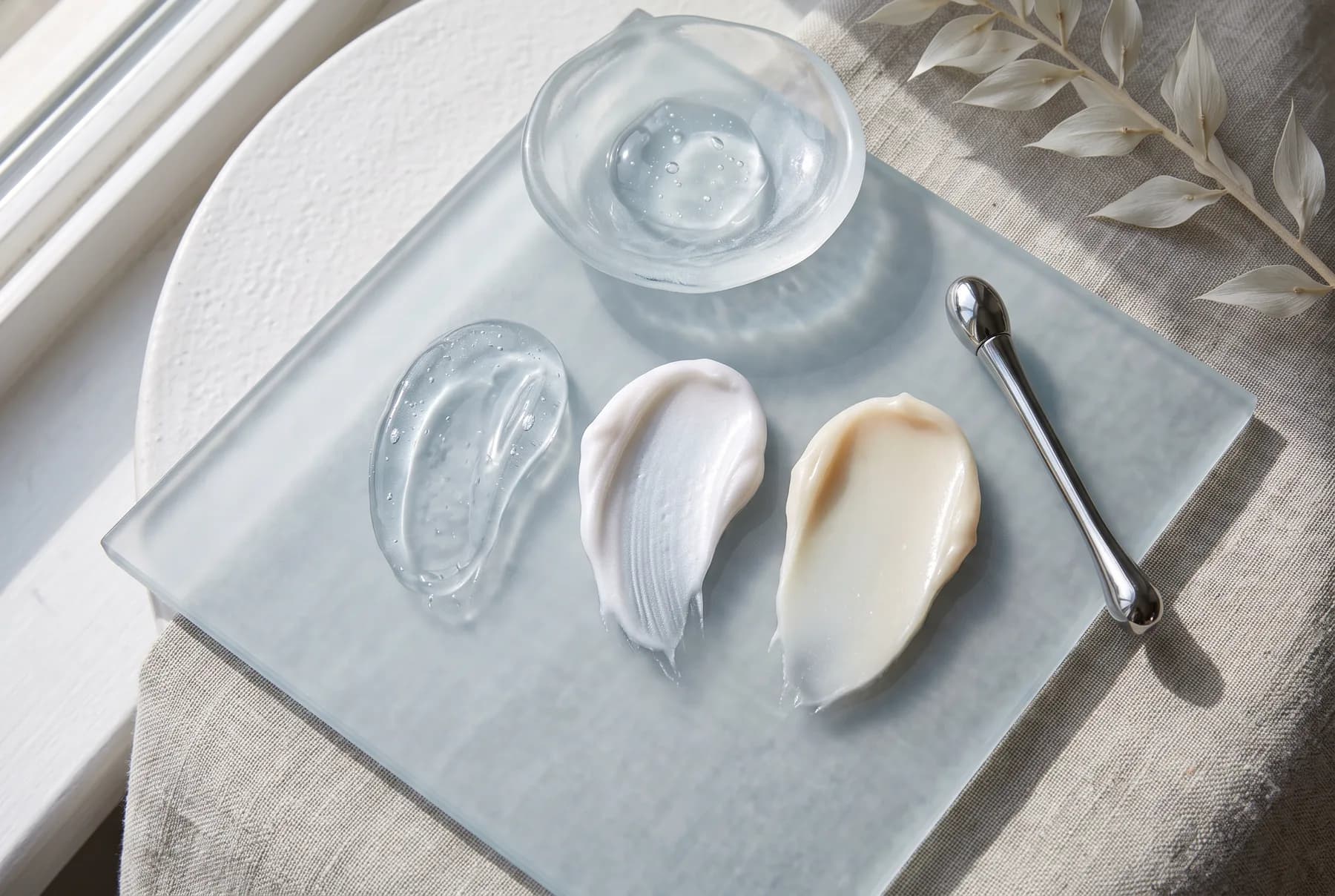
Choose a humectant-rich eye gel or cream, then seal it with a light cream if the skin still feels dry. Hyaluronic acid works well in a fluid gel, while ceramides tend to show up in more cushiony cream formulas. The goal is a plush, flexible finish—not a thick layer that migrates into the eyes.
- Look for hyaluronic acid or glycerin near the ingredient story, plus ceramides if dryness is a repeat issue.
- Choose a gel if you prefer a quick-drying layer under concealer or tend to dislike residue.
- Choose a cream or balm if flaking, tightness, or a crepey surface is more noticeable than puffiness.
- Apply a rice-grain-sized total amount for both eyes, then add only a trace more if needed.
For persistent fine texture and sun-related aging concerns
A low-strength retinol eye cream is a sensible at-home treatment category to consider, particularly in the 0.025% to 0.1% range cited for eye-area formulas. Retinaldehyde is another vitamin A derivative found in smoothing-focused products. In either case, an eye-specific formula with a creamy base can make an active feel more manageable than a bare, high-strength facial treatment.
- Start with the lowest practical strength and a slow schedule rather than chasing a dramatic percentage.
- Favor formulas that also include humectants or barrier-supportive ingredients to soften the feel of the active.
- Use it at night, keeping product on the orbital bone rather than at the lash line.
- Pause if you develop persistent stinging, redness, peeling, or dryness.
For someone who cannot tolerate retinoids
Peptide-rich creams and gel-creams are a useful alternate lane. Search for palmitoyl or acetyl peptide names, or copper peptides, then assess the whole formula: a peptide treatment in a soothing, hydrating base may be more wearable than a densely fragranced cream with a longer ingredient list.
This is also the lane for an uncomplicated barrier-first routine. It may not feel as glamorous as an “intensive” treatment, but consistency is easier when your eye area is calm enough to tolerate daily moisturizing and daytime sunscreen.
Build an at-home routine that respects the eye area

A good routine for fine lines under eyes is deliberately unexciting: cleanse gently, use one targeted treatment at a time, moisturize according to your skin’s needs, and protect exposed skin from ultraviolet exposure every morning. The treatment does not need to be placed directly beneath the lashes to be useful; product can migrate with warmth and movement.
Morning
The morning routine is primarily about hydration, comfort beneath makeup, and sun protection. If your sunscreen stings around the eyes, adjust the placement and consider discussing eye-area sunscreen options with a dermatologist rather than forcing a product that makes you water or rub your eyes.
- Cleanse gently, or rinse with lukewarm water if your skin does not need a full morning cleanse.
- Press a small amount of hyaluronic acid gel, peptide gel-cream, or lightweight moisturizer around the orbital bone.
- Apply moisturizer if your chosen treatment is not moisturizing enough on its own.
- Finish with broad-spectrum sunscreen on the face and around the eye contour, taking care to avoid getting it into the eyes.
Evening
Night is the better window for a retinol or retinaldehyde eye treatment because there is no need to layer it under sunscreen and makeup. If your skin is sensitive, use a moisturizer-first approach: a thin veil of plain cream, then a tiny amount of active treatment, followed by cream where needed.
- Remove makeup and sunscreen without tugging at the eye area.
- On designated treatment nights, dot a low-strength retinol or retinaldehyde eye cream around the orbital bone.
- On non-retinoid nights, use a peptide or hydration-focused formula instead.
- Finish with a ceramide-containing moisturizer or a small amount of an occlusive nighttime cream if dryness persists.
Layering, texture, and value: what is worth paying for
Eye products are often sold in small sizes, which makes value less about the jar’s appearance and more about whether the formula fills a specific gap in your routine. If you already use a gentle facial moisturizer with ceramides around your orbital bone without irritation, you may not need a separate barrier cream. A dedicated eye product earns its place when its texture, active level, or applicator-free precision makes consistent use easier.
Texture is practical, not merely aesthetic. Watery gels are useful for people who prefer a weightless finish or wear concealer; cream-serums can bridge hydration and treatment; balms and dense creams make the most sense when dryness is a central concern. A product that pills under makeup or leaves eyes watery is unlikely to become a daily habit, no matter how sophisticated its ingredient list.
Use these criteria before committing to an eye treatment:
- Match format to routine: A fast-absorbing gel is easier in the morning, while a creamier retinoid or ceramide formula often suits night.
- Check active overlap: Avoid stacking several potentially irritating treatment products around the same small area.
- Prioritize packaging and usability: A product that dispenses a controlled amount can help prevent overapplication.
- Read for fragrance sensitivity: If you react easily, a simpler, fragrance-free formula may be the more comfortable choice.
- Set a realistic finish preference: Dewy is not always better if it causes makeup to crease; matte is not always better if the area feels tight.
When an in-office treatment may make more sense

At-home care is a sensible foundation, but it has boundaries. If lines are strongly tied to facial movement, a persistent etched pattern, or a visible hollow that does not change with moisturizing, a consultation with a board-certified dermatologist or appropriately qualified aesthetic clinician can clarify the category of treatment under discussion.
Professional options may include fractional lasers, microneedling, superficial chemical peels, neuromodulator injections for dynamic lines, and hyaluronic acid filler for volume-related creases. Each has a distinct target, recovery profile, cost structure, and risk profile; “stronger” is not automatically better for the eye area.
| Option to discuss | Often considered when | Key practical consideration |
|---|---|---|
| Fractional laser | Texture and photodamage are central concerns | Requires eye protection and can involve downtime |
| Microneedling | Gradual texture-focused improvement is the goal | Treatment protocols vary; ask about experience around the eye area |
| Superficial chemical peel | Surface dullness and fine texture are concerns | Peels require careful selection and eye-area protection |
| Neuromodulator injection | Lines appear chiefly with smiling or squinting | It targets muscle movement, not dehydration or hollowness |
| Hyaluronic acid tear-trough filler | A crease is substantially related to volume loss | This area carries serious risks and requires an experienced injector |
Questions to bring to a consultation
Bring an uncluttered goal, not just a procedure name. A good consultation should distinguish what appears at rest from what appears during expression, and should make room for questions about protection, downtime, and alternatives.
- Is my concern mainly dynamic lines, surface texture, or volume loss?
- What improvement is reasonable for my skin thickness and eye-area anatomy?
- What downtime, aftercare, and eye protection does this option require?
- What are the specific risks in the under-eye area, and how are complications managed?
Fillers near the eye deserve particularly careful decision-making. Potential complications include a bluish Tyndall effect and vascular occlusion, so injector experience and a thorough risk discussion are essential rather than optional.
Safety rules that make eye care smarter
The eye contour is not the place for aggressive experimentation. A routine can be effective and still be gentle enough to sustain; if a product repeatedly burns, triggers watering, or leaves the skin visibly irritated, stopping is a better strategy than trying to “push through.”
- Keep potent treatments away from the lash line and do not apply them to broken or actively irritated skin.
- Introduce one new formula at a time so you can identify what your skin tolerates.
- Patch-test new treatments before regular use, especially if you have sensitive skin.
- Wear sunscreen consistently; a nighttime active does not replace daytime photoprotection.
- Seek professional advice before procedures, and confirm that lasers and peels include appropriate eye protection.
Related reading
- Best Eye Cream for Dry Skin and Wrinkles
- Best Serum for Wrinkles and Fine Lines
- Best Product for Forehead Wrinkles: Smart Guide
Frequently asked questions
Can eye cream get rid of fine lines under eyes?
A hydrating eye cream can temporarily make dehydration lines look softer, while retinoid- or peptide-focused formulas may support a gradual smoothing routine. It cannot erase every type of line, especially creases driven by expression or volume loss.
Is retinol safe around the eyes?
Low-strength retinol products formulated for the eye area are commonly used, but tolerance varies. Start slowly, keep it away from the lash line, patch-test, and discontinue if irritation or stinging occurs.
Should I use an eye gel or eye cream for fine lines?
Choose a gel for a light, quick-absorbing layer and a cream for more cushioning moisture. If fine lines look worse when the area feels dry or tight, a cream with humectants and ceramides is often the more logical format.
What is best for crow's feet that appear when I smile?
Those are often dynamic lines, meaning movement is a major factor. Hydration and topical care can improve surface comfort, but a clinician can explain whether a neuromodulator discussion is appropriate for your goals.
Sources
- American Academy of Dermatology — Dry skin and moisturizers guidance
- Cleveland Clinic — How to Pick the Eye Cream That's Right for You
- Park et al. — Aesthetic procedures review
Clear guidance, checked before publication.
Solvi articles are structured by our editorial team and reviewed for clarity, consistency, and responsible health language. We update pages when guidance or product information changes.

Maya Bennett
Senior Beauty Editor. Maya turns big beauty questions into clear, grounded guidance, with a focus on routines that respect real skin, schedules, and budgets.