PDRN cream: how to judge the evidence before buying

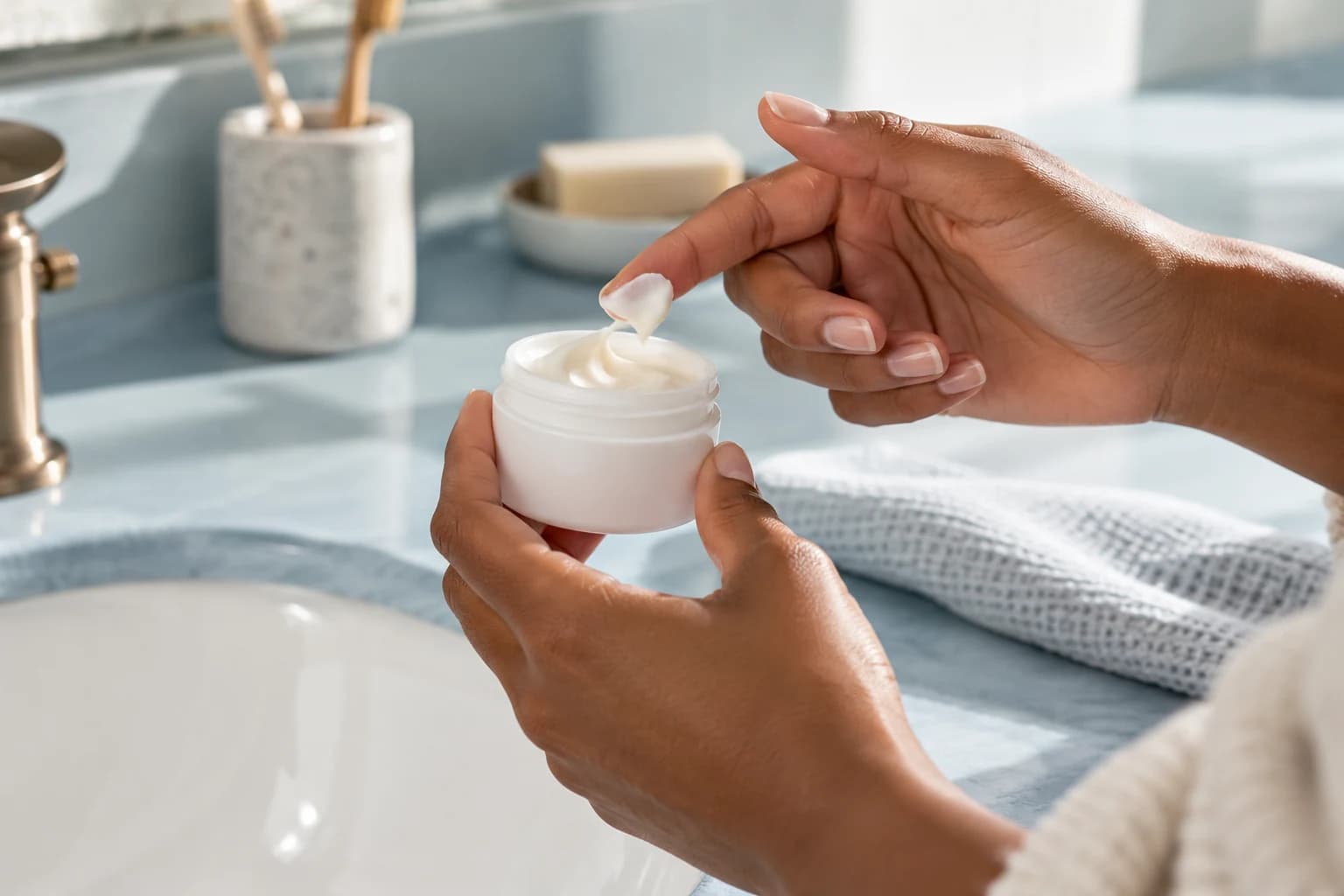
A PDRN cream is a moisturizer containing a DNA-derived ingredient marketed for skin benefits. Some topical research is promising, but results depend on the preparation and study. The words “PDRN,” “salmon DNA” or “regenerative” on a jar do not establish that it will rebuild your skin, reduce scars or match an injection treatment.
If you want to try one, choose a moisturizer you would still consider without the headline ingredient: suitable formula, clear source information, comfortable use and a price you can justify. Then examine any additional evidence for the specific finished product.
Start with the exact product
PDRN stands for polydeoxyribonucleotide. Cosmetic lists may use ingredient names such as Sodium DNA, so the marketing name and ingredient-panel wording can differ. Ask the manufacturer for clarification when it is unclear what the product contains.
Anua PDRN Hyaluronic Acid 100 Moisturizing Cream, for example, lists Sodium DNA and identifies salmon as the source. That is useful product information; it does not make every PDRN cream equivalent to Anua or establish the same formula across other products in that range.
Check the full brand, product name, size and region. Similarly named creams, serums and professional products can have different directions. RejuAll and Rejuran should not be treated as interchangeable names, and a description of an injectable should not stand in for a moisturizer's ingredient list.
What counts as useful evidence
Separate three questions: does the ingredient have biological activity, can the preparation reach the relevant site, and does the finished product improve a meaningful outcome in people? A laboratory answer to the first question does not automatically answer the third.
| Evidence you encounter | What it can help establish | What it cannot establish alone |
|---|---|---|
| Cell or laboratory experiment | A possible biological mechanism | A visible result from your face cream |
| Animal or wound-care study | Findings under that specific experimental or clinical condition | Routine cosmetic performance on intact skin |
| Injection study | Results for the injected preparation and protocol | Equivalent results from spreading a cream on skin |
| Human study of the exact cream | Outcomes for the tested product, population and use | A guarantee that every shopper will respond |
A 2022 study often relevant to online discussions used a mixture of PDRN, vitamin C and niacinamide delivered with microneedling in a UV-exposed animal model. That is far removed from applying a daily moisturizer at home.
Topical research has continued. A 2026 report tested a particular 0.1% PDRN eye cream in a 28-day split-face comparison with 0.1% retinol. The finding should be read as evidence about that preparation and comparison, not a verdict that every PDRN moisturizer outperforms retinol.
Ask better questions about a clinical claim
Before paying extra for a study claim, look for enough detail to understand it:
- Was the exact product sold to consumers the one tested?
- Was there a comparison group or comparison side?
- How many people participated, and for how long?
- Was the result a measured change, a participant opinion or a laboratory finding?
- Were participants using other products or procedures?
- Does the measured outcome match your concern?
A hydration measurement, a satisfaction survey and a reduction in scar depth would answer different questions. A large percentage without that context is difficult to use for a buying decision. You do not have to disprove a claim to decide it is insufficiently clear to justify a premium.
Ingredient order cannot reveal an effective dose
Do not rank PDRN creams by how high Sodium DNA appears in the ingredient list. Under US cosmetic labeling rules, ingredients present at 1% or less may be listed in any order after those above 1%. The list also does not supply a universally established effective topical PDRN threshold.
A disclosed percentage is more informative about quantity, but quantity alone is not effectiveness. Formulation, delivery, study conditions and the outcome measured still matter. “More PDRN” is therefore not a reliable standalone score.
Use the ingredient list for what it does well: identifying ingredients you want to avoid, comparing versions and checking whether a claimed ingredient is present. Use product-level research, where available, for questions about performance.
Compare the moisturizer you will actually use
Imagine two jars with different PDRN claims. One has a finish you enjoy under sunscreen; the other feels too heavy and stays unused. The first has a clearer practical role, even if the second emphasizes a larger-sounding number.
Compare the complete routine cost as well. A matching PDRN serum, cream and mask are three purchases; using all of them together does not tell you which one improved your experience. Start with the step that is missing or unsatisfactory.
A useful value check is cost per amount of product, followed by whether that amount fits how you use it. This does not measure clinical strength. It simply avoids comparing a tiny container with a large one as if their shelf prices represented the same purchase.
Three situations that lead to different decisions
You want a different daily moisturizer. A PDRN cream can be one candidate. Check the formula, source and finish alongside ordinary alternatives. You can enjoy the product without assigning every benefit to PDRN.
You want to improve a specific scar or persistent skin condition. Start with assessment and treatment options for that concern. A general moisturizer claim is insufficient to choose a treatment for a different problem.
You are planning or recovering from a procedure. Ask the treating clinician about aftercare. A product associated online with repair is not automatically appropriate for recently treated skin, and a cosmetic routine should not replace procedure-specific instructions.
These scenarios have different goals and evidence requirements. Keeping the goal explicit is the easiest way to avoid buying a product for a benefit it has not actually demonstrated.
Source and allergy questions come before experimenting
Many PDRN products use fish-derived material, but verify the actual source rather than assuming all formulas are identical. A known fish allergy deserves a discussion with your allergist and, when needed, the manufacturer. A home tolerance check cannot establish that an uncertain fish-derived product is safe for that allergy.
Fish and shellfish allergies are distinct. Ingredient origin alone also cannot reveal residual protein content or an individual's risk. Avoid both blanket reassurance and the claim that every DNA-containing cosmetic inevitably causes fish-allergy reactions.
For ordinary cosmetic irritation, stop a new product that causes a reaction and seek advice if symptoms persist or are significant. Keep the packaging and ingredient list; they are more helpful for investigating the problem than the general category name.
Frequently asked questions
Does PDRN cream replace moisturizer?
Many PDRN creams are moisturizers. If the product provides the comfort you need, an additional cream is not automatically necessary. Check the exact product's directions and how it fits your routine.
Can I use PDRN cream with retinol?
There is no universal answer based only on the PDRN label. Check the entire formula and the directions for both products. Follow prescribed retinoid instructions and ask the prescriber if adding the cream creates uncertainty.
Does PDRN low on the ingredient list mean it is useless?
No. Ingredient position cannot establish an effective or ineffective dose. A low position also does not prove that the product works. Look for relevant finished-product evidence and assess whether the moisturizer itself meets your needs.
Are injections stronger versions of the same cream?
They are different interventions with different delivery, protocols and evidence. A result from an injected product cannot be converted into an expected result from a topical cosmetic.
Related reading
- Anua PDRN cream: ingredients and value
- Best moisturizer for sensitive skin
- Best moisturizer for dry, sensitive, acne-prone skin
Sources
- Anua US: Example of a PDRN cream ingredient list
- FDA: Cosmetics labeling guide
- 2022 study: PDRN combination delivered with microneedling in an animal model
- Topical medium-length PDRN: formulation-specific clinical study
- American College of Allergy, Asthma and Immunology: Fish allergy
- American Academy of Allergy, Asthma and Immunology: Allergy testing
Clear guidance, checked before publication.
Solvi articles are structured by our editorial team and reviewed for clarity, consistency, and responsible health language. We update pages when guidance or product information changes.

Zoe Mitchell
Beauty Trends Editor. Zoe keeps a close eye on viral routines, new launches, and the skincare conversations moving fastest online. She asks which trends are useful, which need context, and which can be skipped.