
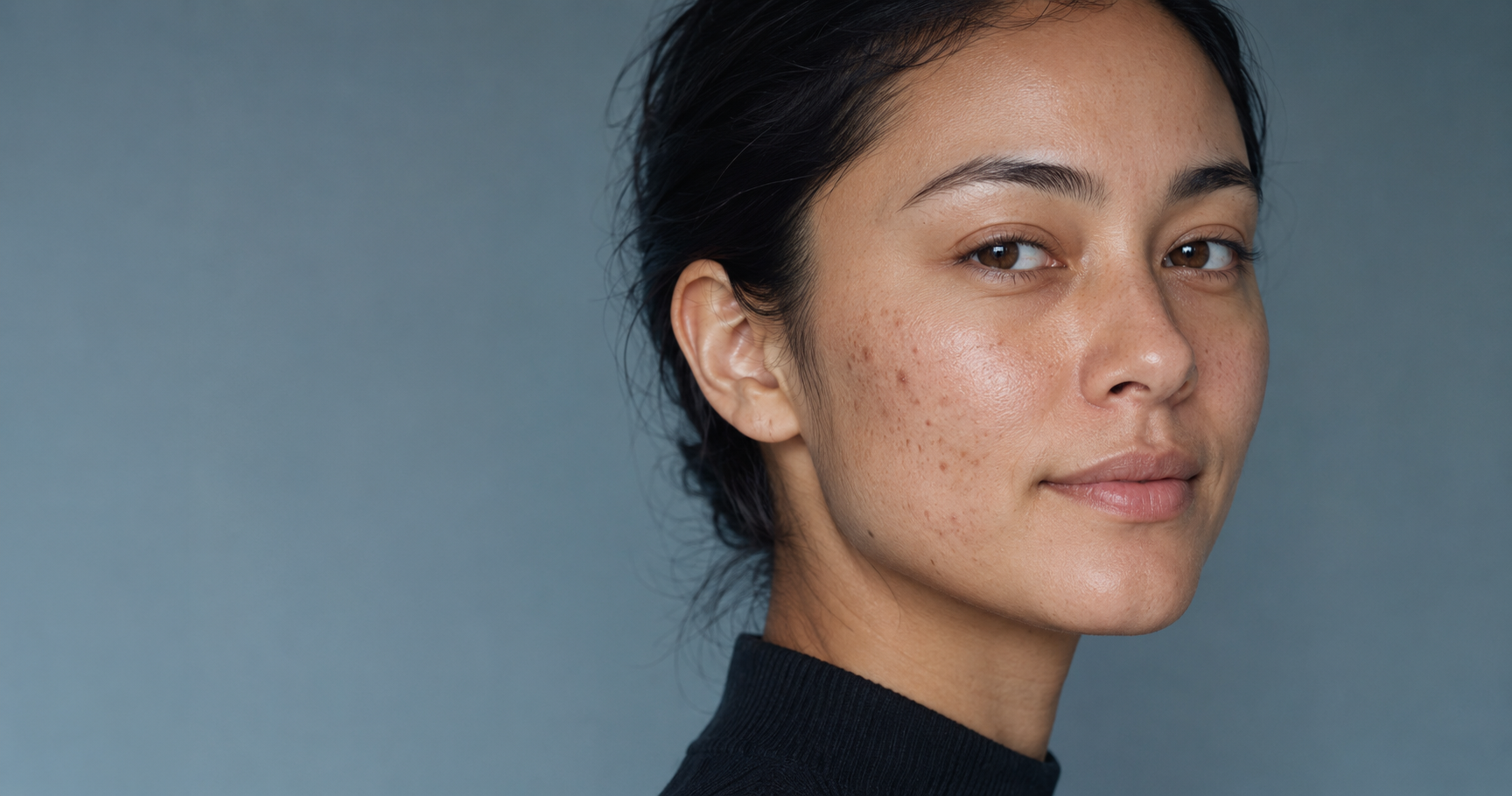
A breakout may disappear while leaving something behind: a red, brown, gray, pale, indented, or raised area where the blemish used to be. These changes are often grouped together as "acne scars," but they do not all represent the same process.
The simplest distinction is texture. A flat change in color is usually considered a post-acne mark rather than a true scar. A lasting depression or raised area involves a change in the skin's structure and is more consistent with scarring. That distinction matters because products that support uneven-looking tone cannot rebuild every type of textured scar.
This guide can help you describe what you see and prepare for a more useful conversation with a dermatologist. It is educational and cannot diagnose a skin condition from a photograph.
The short answer: marks change color, scars change texture
Post-acne marks are usually flat. Depending on your skin tone and the healing response, they may look pink, red, purple, brown, gray, or lighter than the surrounding skin. These areas can become less noticeable over time, although the process may take months or longer.
Acne scars affect the contour of the skin. They may look indented, pitted, wavy, firm, or raised. Scars can also exist alongside discoloration, so one area may have both a color change and a texture change.
When observing an area after a breakout, ask:
-
Does it feel level with the surrounding skin?
-
Does side lighting reveal a dent, edge, or raised surface?
-
Is the main difference color rather than shape?
-
Has the area changed gradually since the breakout healed?
These questions are useful for describing the concern, but they do not replace an in-person examination.
What are post-acne marks?
Post-acne marks are visible color changes that remain after inflammation settles. They are not always permanent and do not necessarily mean that scar tissue has formed.
Red or pink marks
After an inflamed blemish heals, some people notice a flat red or pink area. This is commonly described as post-inflammatory erythema. DermNet notes that this type of color change is seen more often in lighter skin tones and is associated with vascular changes during healing.
The area may become more visible after exercise, heat, or other situations that temporarily increase facial redness. Because it is flat, it may look different under changing light without casting the shadow commonly associated with an indented scar.
Brown, gray, or purple marks
Post-inflammatory hyperpigmentation, often shortened to PIH, develops when inflammation is followed by increased pigment in the affected area. It can appear brown, gray, or purple depending on skin tone, the depth of pigment, lighting, and other factors.
PIH is especially common and persistent in deeper skin tones, although it can occur in anyone. Additional irritation may make uneven-looking pigmentation more noticeable, which is one reason aggressive scrubbing or frequently changing products can be counterproductive.
Lighter marks
Some healed areas look lighter than the surrounding skin. This is known as post-inflammatory hypopigmentation. Like red and dark marks, a flat pale area is not automatically a textured acne scar. A dermatologist can help assess persistent or changing areas, particularly when the cause is uncertain.
What are acne scars?
Acne scars develop when healing changes the skin's structure. According to the American Academy of Dermatology, depressed scars can form when the body produces too little collagen during healing, while raised scars can form when too much collagen is produced.
Different scar shapes may respond differently to treatment. A person can also have more than one scar type in the same area.
Ice pick scars
Ice pick scars are narrow depressions that extend more deeply into the skin. Their opening may look small, but the visible depth can create a pronounced shadow. They are commonly found on areas such as the cheeks.
Boxcar scars
Boxcar scars are round or oval depressions with more defined edges. They are generally wider than ice pick scars and can vary in depth. The sharper border can make them easier to see in angled lighting.
Rolling scars
Rolling scars are typically wider and shallower, with sloping edges. When several appear together, the skin may have an uneven or wave-like contour rather than separate sharply defined pits.
Raised scars
Some acne scars rise above the surrounding skin. Hypertrophic scars generally remain within the area affected by the original inflammation, while keloids can extend beyond it. Raised scarring is more frequently reported in deeper skin tones and commonly appears around the jawline, chest, shoulders, or back.
A new, growing, painful, itchy, or otherwise concerning raised area should be assessed by a qualified clinician rather than treated as a cosmetic issue at home.
How to compare a mark and a scar at home
You do not need special equipment to document a visible change, but consistent conditions make comparison more useful.
Look in soft, even light
Strong overhead light can exaggerate every shadow, while a front-facing beauty light can flatten texture. Stand near a window with indirect daylight and keep the camera at approximately the same distance each time.
Observe color and contour separately
First note the color: red, pink, purple, brown, gray, pale, or close to your surrounding skin tone. Then look at the surface. Is it flat, indented, or raised?
Separating these observations prevents a dark shadow inside a depression from being mistaken for pigmentation alone.
Compare photographs taken under similar conditions
Changes in makeup, expression, camera processing, angle, and lighting can make an area look better or worse even when the skin has not meaningfully changed. Use the same room, distance, angle, and neutral expression whenever possible.
Solvi can help organize consistent progress photos and visible observations over time. It does not diagnose acne, pigmentation disorders, or scar types, and its images should not replace an examination by a licensed professional.
Why the distinction affects treatment
Color changes and structural scars are different concerns, so they may require different approaches. No single cream, device, or procedure is appropriate for every mark or scar.
Approaches commonly discussed for post-acne marks
Managing ongoing acne is an important first step because new inflammation can create new marks while older ones are fading. Gentle skin care can also reduce avoidable irritation.
The American Academy of Dermatology recommends broad-spectrum, water-resistant SPF 30 or higher when outdoors. Sun protection is particularly relevant when uneven pigmentation is a concern and when using treatments that increase sun sensitivity.
Depending on the person and the type of discoloration, a dermatologist may discuss topical options. Retinoids are among the ingredients used for acne and some pigmentation concerns, but they can cause irritation and are not appropriate for everyone. Pregnancy, sensitivity, other skin conditions, and the rest of a routine must be considered before starting one.
Approaches commonly discussed for textured scars
Moderate or deep textural scars usually require professional assessment. Options described by dermatology organizations include chemical peels, microneedling, radiofrequency, laser procedures, fillers, scar surgery, and selected topical medications for milder scarring.
The appropriate option depends on factors such as:
-
whether scars are depressed or raised;
-
the specific scar shape and depth;
-
skin tone and the risk of pigment changes;
-
whether active acne is controlled;
-
previous treatments and healing history;
-
expected downtime, cost, and realistic goals.
Combination treatment is common because different scar types may not respond equally to one procedure. A provider's experience treating skin tones similar to yours is particularly important when a procedure carries a risk of post-inflammatory pigmentation.
What not to do
Do not pick or squeeze active acne
Picking can increase inflammation and the likelihood of both discoloration and scarring. If recurring breakouts are leaving marks, addressing the acne itself is usually more useful than repeatedly treating each new spot afterward.
Do not assume stronger means faster
Stacking exfoliating acids, scrubs, retinoids, and spot treatments can damage the skin barrier and increase irritation. More irritation may make redness or pigmentation look worse.
Do not perform professional procedures at home
Deep peels, high-strength acids, aggressive microneedling, and unregulated devices can cause burns, infection, pigmentation changes, or additional scarring. Procedures intended to remodel scar tissue should be discussed with a licensed professional.
Do not judge progress from unrelated photos
A brighter room, a closer camera, automatic phone sharpening, or a different expression can change how texture appears. Compare like with like and look for a pattern across several consistent check-ins rather than one flattering or discouraging image.
When to see a dermatologist
Consider professional care when:
-
acne is painful, deep, persistent, or beginning to scar;
-
a raised area is growing, itchy, painful, or extends beyond the original blemish;
-
a mark is changing in an unexpected way;
-
over-the-counter products repeatedly cause irritation;
-
discoloration or texture is affecting your confidence or quality of life;
-
you are considering a peel, laser, microneedling, filler, or scar surgery;
-
you are unsure whether the area is related to acne at all.
Earlier acne treatment may reduce the chance of additional scars. You do not need to wait until every breakout has stopped before asking a dermatologist how to prevent further damage.
Frequently asked questions
Do acne marks fade on their own?
Many flat post-inflammatory color changes become less noticeable with time, but the timeline varies. Skin tone, sun exposure, repeated inflammation, irritation, and the type of color change can all affect how long it remains visible.
Can skin care remove indented acne scars?
Topical skin care may improve overall tone, dryness, or the appearance of mild irregularities, but it cannot fully correct every structural depression. A dermatologist can identify the scar pattern and explain which professional options may be appropriate.
Can one spot be both a mark and a scar?
Yes. A textured scar can also have redness, hyperpigmentation, or hypopigmentation. Tracking color and texture separately makes the change easier to describe.
Does every deep breakout leave a scar?
No. Deeper inflammation increases the likelihood of scarring, but it is not possible to predict perfectly who will scar. Genetics, inflammation, picking, acne severity, and individual healing responses can all play a role.
Can Solvi tell me which scar type I have?
Solvi can help you capture consistent images and organize visible observations, but it does not diagnose scar types or recommend medical procedures. Use it as a progress-tracking tool and seek a dermatologist for diagnosis or treatment decisions.
A practical next step
Start by separating three questions:
-
Is the area flat, indented, or raised?
-
Is its color different from the surrounding skin?
-
Is active acne still creating new areas?
Capture a baseline in soft, even light and repeat the same angles under similar conditions. If texture is persistent, acne is still active, or the area concerns you, bring those observations and photographs to a dermatologist. A clear record cannot replace clinical care, but it can make the conversation more specific.
Sources
-
American Academy of Dermatology: Acne scars — signs and symptoms
-
American Academy of Dermatology: Acne scars — consultation and treatment
This article is for general educational purposes. Solvi does not diagnose, treat, or replace care from a licensed medical professional.
SOLVI SKIN ANALYSIS