
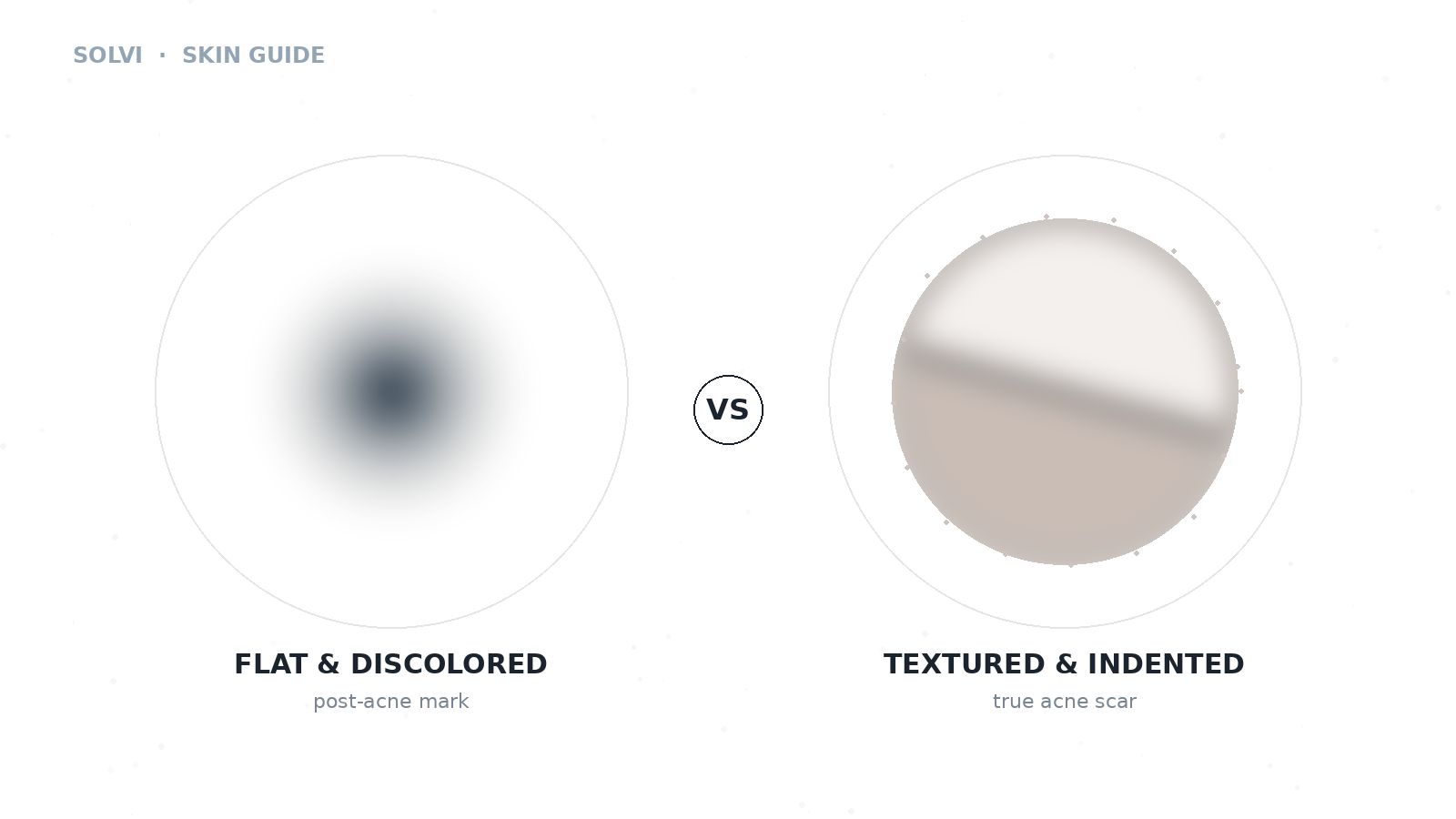
A breakout may disappear in a few days and still leave something behind for months. Sometimes it is a flat red, purple or brown mark. Sometimes the texture of the skin has changed, creating a small depression or raised area.
Although people often call both of these "acne scars," they are not the same thing. The difference matters because a routine designed to fade discoloration cannot rebuild a depressed scar—and an acne-scar procedure may be unnecessary for a flat mark that can gradually fade.
The Quick Distinction
If the area is flat and only the color has changed, it is more likely to be a post-acne mark. If the skin is raised or indented, it may be a true acne scar.
Solvi can help you create a consistent photo baseline and track visible changes over time. It cannot diagnose a skin condition or replace an examination by a dermatologist.
What Are Post-Acne Marks?
Post-acne marks are flat areas of discoloration that remain after inflammation from a breakout has settled.
They may appear:
- red or pink
- purple
- tan or brown
- gray-brown or nearly black
The American Academy of Dermatology explains that completely flat pink, red, purple, brown or black spots left after acne are frequently mistaken for permanent scars. Unlike a structural scar, these marks can eventually fade, although the process may take months and sometimes longer than a year.
Source: AAD — Acne signs and symptoms
Dark or Brown Acne Marks
Dark marks are often associated with post-inflammatory hyperpigmentation, or PIH. Inflammation stimulates excess pigment production in the affected area.
PIH can occur in any skin tone, but it is often more noticeable and persistent in medium-to-deep skin tones. Continuing breakouts can create new marks faster than older ones fade.
Red or Pink Acne Marks
Red, pink or purple marks may reflect persistent visible changes in small blood vessels after inflammation. They are often described as post-inflammatory erythema.
A red mark can gradually become less noticeable, but it should not automatically be treated as pigmentation. Products intended to reduce excess pigment may not address redness in the same way.
What Are Acne Scars?
A true acne scar changes the texture or contour of the skin.
Acne scars may sit below the surrounding skin or rise above it. The main types include:
- Ice pick scars — narrow depressions that extend deeper into the skin
- Boxcar scars — wider round or oval depressions with more defined edges
- Rolling scars — wider, shallower depressions that create an uneven or wavy texture
- Hypertrophic scars — firm, raised scars caused by excess tissue formation
- Keloids — raised scars that grow beyond the original area of inflammation
The type of scar affects which professional treatment may be appropriate. Procedures used for a shallow rolling scar, for example, may not be suitable for a deep ice pick scar or a raised keloid.
Source: AAD — Acne scar types
Acne Mark or Acne Scar?
Look at the area in soft, even light without a beauty filter.
| What you see | More consistent with |
|---|---|
| Flat skin with a brown, gray or dark spot | Post-inflammatory hyperpigmentation |
| Flat skin with a pink, red or purple spot | Post-inflammatory redness |
| A small deep indentation | Ice pick scar |
| A wider depression with defined edges | Boxcar scar |
| Shallow, uneven or wave-like texture | Rolling scar |
| A firm raised area | Hypertrophic scar or keloid |
This visual check is not a diagnosis. Lighting, makeup, camera processing and facial expression can make texture and color look different in photographs. If you are unsure—or if the area is painful, changing or raised—ask a qualified medical professional.
What Can Help Acne Marks Fade?
1. Control Active Breakouts First
Treating old marks while new acne continues to form can feel like trying to empty a bathtub while the tap is still running.
Early and consistent acne treatment can reduce the likelihood of additional discoloration and scarring. The American Academy of Dermatology recommends treating acne and dark spots together rather than focusing only on the marks.
Source: AAD — Acne and dark spots
If you regularly develop deep, painful nodules or cysts, over-the-counter skincare may not be enough. These forms of acne have a greater risk of leaving lasting scars and should be assessed by a dermatologist.
2. Avoid Picking and Squeezing
Picking can push inflammation deeper into the skin and increase the risk of infection, discoloration and permanent scarring.
A hydrocolloid patch may help protect an individual blemish from touching, but it does not replace an acne treatment plan.
3. Use Sunscreen Consistently
UV exposure can make post-inflammatory discoloration more persistent and more visible.
Choose a broad-spectrum, water-resistant sunscreen with SPF 30 or higher and use it according to the product directions. "Broad spectrum" means the product provides protection against both UVA and UVB radiation.
Source: FDA — The sun and your medicine
For acne-prone skin, look for labels such as:
- non-comedogenic
- oil-free
- won't clog pores
Sunscreen does not erase an existing mark overnight. Its role is to reduce additional UV-related darkening while the skin recovers.
4. Introduce Active Ingredients Carefully
Depending on the type of acne and discoloration, a dermatologist may recommend ingredients such as:
- azelaic acid
- a topical retinoid
- salicylic acid
- benzoyl peroxide for active inflammatory acne
Azelaic acid and topical retinoids may be used in plans addressing both acne and dark post-acne marks. Salicylic acid can help keep pores clear, while benzoyl peroxide may help manage inflammatory acne.
Source: AAD — Acne diagnosis and treatment
More ingredients do not necessarily produce faster results. Combining several exfoliants or starting multiple strong products at once can cause irritation. That irritation may make redness or post-inflammatory pigmentation more noticeable.
Introduce one change at a time and follow the product instructions. Ask a healthcare professional about ingredients that may be unsuitable during pregnancy, breastfeeding or alongside prescription treatment.
5. Track Change Under Comparable Conditions
Post-acne marks usually change gradually, which makes improvement difficult to judge from memory.
Take progress photos using:
- the same room
- similar daylight
- the same camera
- a similar distance and angle
- a neutral expression
- no beauty filter
- minimal or no makeup
Compare changes over several weeks, not from one day to the next.
Can Skincare Remove Indented Acne Scars?
Skincare may support the skin barrier and improve the overall appearance of the skin, but topical products generally cannot fully correct a structural depression or raised scar.
Professional acne-scar treatment depends on the scar type and may involve more than one approach. Dermatologists may use procedures such as chemical peels, scar surgery, fillers, lasers or other techniques for depressed scars. Raised scars require a different strategy and may involve injections, laser treatment or prescription medication.
Source: AAD — Acne scar treatment
Procedures also carry risks, including irritation and additional pigmentation changes. A systematic review of PIH treatments found that some laser and energy-based treatments worsened pigmentation in a small proportion of studied patients. This makes professional assessment particularly important for people prone to post-inflammatory pigmentation.
Source: Systematic review — PIH treatment outcomes
What Not to Do
Avoid trying to speed up fading by:
- scrubbing the area aggressively
- picking healing pimples
- using several acids in the same routine without guidance
- performing strong chemical peels at home
- applying unverified bleaching mixtures
- treating an indented scar as if it were only pigmentation
- changing your entire routine every few days
Irritation can create more inflammation, making it harder to understand whether the original mark is improving.
When to See a Dermatologist
Consider professional care when:
- acne is deep, painful or leaving new scars
- a mark is raised, growing or changing
- the skin has visible indentations
- discoloration continues to worsen
- over-the-counter treatment causes persistent burning, swelling or peeling
- you are unsure whether you have pigmentation, redness or scarring
- acne or its after-effects are affecting your confidence or daily life
Seek prompt medical attention for a spot that bleeds, rapidly changes, becomes infected or does not resemble your usual acne.
Build a Clearer Baseline With Solvi
It is easier to evaluate gradual change when your photos and routine are organized in one place.
Solvi helps you:
- create a consistent visual baseline
- organize visible concerns
- build a simpler skincare routine
- track products and routine consistency
- compare progress over time
Solvi provides educational skincare guidance and tracking. It does not diagnose acne, classify scars medically or replace care from a licensed professional.
Frequently Asked Questions
How long do acne marks take to fade?
Some marks become less visible over several months, while darker or repeatedly irritated areas can remain longer. The timeline varies with skin tone, inflammation, sun exposure, new breakouts and the type of mark.
Are red acne marks scars?
Not necessarily. A completely flat red or pink area is more likely to be a post-inflammatory mark than a structural scar. A dermatologist can assess persistent redness or any accompanying texture change.
Can acne marks disappear without treatment?
Many flat post-acne marks gradually fade. Consistent sun protection, control of active acne and avoidance of picking can support the process.
Does vitamin C fade acne marks?
Vitamin C is used in products marketed for uneven tone, but formulation, stability and concentration vary considerably. It should not replace acne control, sunscreen or professional care when discoloration is persistent.
Can retinol remove acne scars?
A retinoid may support acne treatment and help with some dark post-acne marks. It cannot fully lift deep ice pick, boxcar or rolling scars. Structural scars often require assessment and treatment by a dermatologist.
Reviewed Sources
- American Academy of Dermatology: Acne signs and symptoms
- American Academy of Dermatology: Acne diagnosis and treatment
- American Academy of Dermatology: Acne scar types
- American Academy of Dermatology: Acne scar treatment
- FDA: The sun and your medicine
- Systematic review: Treatment outcomes for post-inflammatory hyperpigmentation
Last reviewed: August 25, 2026
SOLVI SKIN ANALYSIS